

F2-2-8
Part2 往復書簡/Correspondence
Postscript#4 RUI Architects ⇄ clovisbaronian
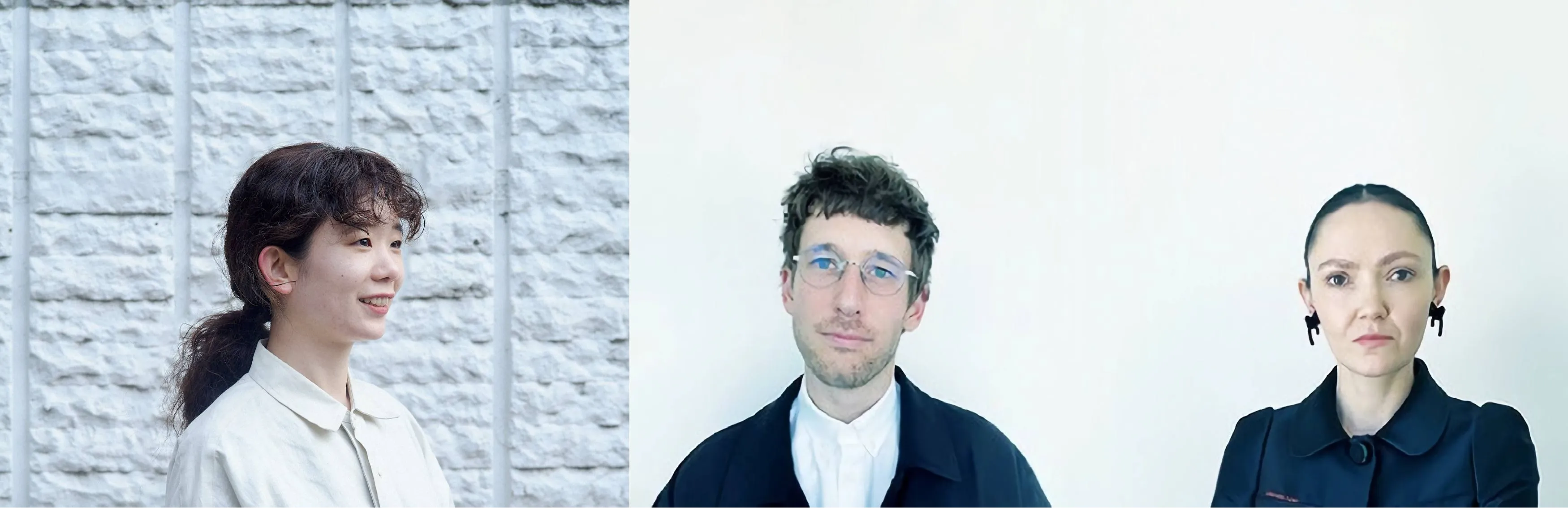
- 編集·翻訳:服部真吏
Editing & Translation: Mari Hattori
東京とニューヨーク、ふたつの展覧会を終えたところで、下記4つの質問を8組の建築家に投げかけました。それぞれの回答を、これまで共に「往復書簡」のプロジェクトを取り組んできたペアごとに、4つの記事に分けて紹介します。
Postscript#4では板坂留五とクローヴィスバロニアンの回答を通して彼らのコラボレーションを振り返ります。展覧会前に交わした過去の往復書簡はこちらよりご覧ください。
After the two exhibitions in Tokyo and New York, the eight groups of architects responded to the following four questions. Each response is collected and presented in four articles. One article is for each pair that has worked together on the project.
Postscript#4 highlights the collaboration between RUI Architects and clovisbaronian through their responses to the questions. Please click here to read the correspondence between them before the exhibition.
-
Contents
-
東京の展覧会ではどのように磯崎新に応答しましたか。/
How did you communicate with Arata Isozaki at the exhibition in Tokyo?
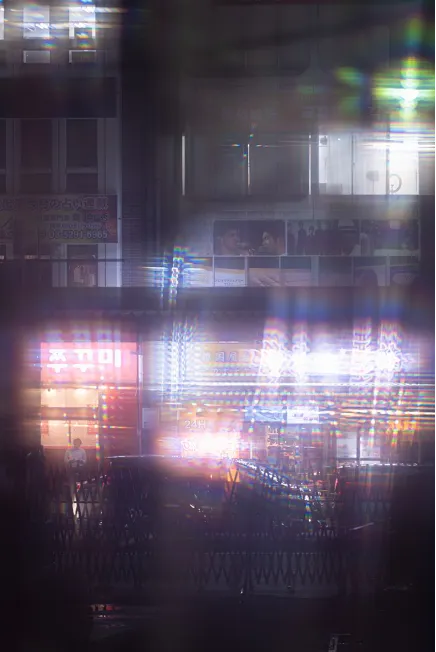
- Fig.1 Installation view of the cloche at the Shinjuku White House. Photo by Kei Murata.
板坂留五 2階の道路に面した既存の窓に対して、それを外から覆う新しい窓《cloche》を制作しました。会場である《新宿ホワイトハウス》の空間は、4作品が一同に介する今回の展示に対して少し窮屈だと感じ、互いの作品同士の適度な距離感をつくるために光や視線の抜けといった外部環境を取り入れたいと考えました。既存の窓は引き違いや網入り曇りガラス、木製のサッシによって室内に意識を向け、身体の働きを促していましたが、鑑賞者と窓のあいだにもう一層空間を用意することで、双方を分ける/分けないの二択ではない、《新宿ホワイトハウス》とその周りの移り変わる状況に応答できる環境を用意しました。
ふたつの窓の間に設けられた、スパッタリング加工されたカーテンも調整役の一端を担っています。窓向こうに見えるギラギラとした歌舞伎町のネオン看板らは、光の粒子に変わることで、情報量が削ぎ落とされた風景となり、室内の静けさとまざりあいます。
時間の流れのなかでそれぞれの時点における意思決定の集積が空間をつくり出していくという考え方として磯崎新の「プロセス・プランニング論」を捉えるならば、私たちが今回の《新宿ホワイトハウス》で展示した《cloche》もそのような空間のつくり方を可能にするのではないかと、作品が完成した後で考えるようになりました。
展示会期が始まってすぐに目の前のレンタカー屋と広い駐車場が解体されてしまいましたが、いずれ歌舞伎町への眺めがなくなった時、この窓はどんな応答をするのでしょうか。
Rui Itasaka A new window, cloche, was created to cover it from the outside in response to the existing window facing the street on the second floor. Since both of us shared a sense that the Shinjuku White House was too small for four installations, we wanted to make passways for light and sightlines to maintain appropriate distance among the works. Existing windows, with their sliding, screened, and wooden sashes, draw a viewer’s attention to the interior and offer his/her actions. By placing another layer of space between the viewer and the window, we prepare an environment that allows the viewer to manage to the changing conditions of the Shinjuku White House and its surroundings without a clear separation between the window and his/her domain.
Additionally, the sputtered curtains between the two windows play the role of coordinator. The glaring neon of Kabukicho over the windows are transformed into particles of light, creating a landscape with a reduced amount of information, mingling with the quietness of the interior.
If Isozaki’s “Process Planning” theory can be understood as the idea that the accumulation of decisions at each point creates a space, then I think cloche follows this way of creating space. We did not discuss such things much during the design process, but we realized it after completion.
Soon after the exhibition opened, the car rental shop and the large parking lot in front of the building were demolished. One day in the future, when we cannot enjoy the view to the Kabukicho from this building, how will this window communicate with?
クローヴィスバロニアン 展示に先駆けて私たちと板坂さんの「往復書簡」をお読みになってくださった皆さんには少し驚きかもしれませんが、新しい窓を板坂さんと協働でデザインし、設置しました。カーペットを制作するという当初の計画は、時間的にも品質的にも実施が難しいことがわかりました。
そこで私たちは一時的なインスタレーションではなく、既存の建築物に溶け込み、建築物の特徴を改善・修正するのに役立つような作品をつくることにしました。もともと、建築の修繕やリユースに対する関心はありましたが、板坂さんとの対話を通して竣工時の建築を完成とみなす建築文化に懐疑的な磯崎新の姿が浮かび上がってきました。
新しい窓は《cloche》と名付けられました。中2階の開口部の上に2層目のガラスを設け、元の窓を保護しながら、その性能(視覚的、音響的)を補強します。既存の開口部を覆っていた大きなガラスを操作することで、磯崎のポストモダン的ファサードによく見られる幾何学的構成の印象を強め、外からの見え方もガラリと変えることができました。アルミの既製品と金物は私たちがアメリカから東京に運び、木枠やガラス、カーテンは板坂さんが日本で用意し、展覧会が始まる約一週間前から現場で一緒に組み立てました。
clovisbaronian In collaboration with Rui Itasaka, we designed and installed a new window for the Shinjuku White House. This may come as a surprise to readers of the earlier correspondence (the original plans to produce a carpet in the Shinjuku White House proved difficult to execute due to time constraints and quality control).
The goal was to create a work in the Shinjuku White House that was not simply a temporary installation but something that could integrate itself into the existing architecture and help to improve or modify the characteristics of the structure. This stemmed from our conversations with Itasaka-san surrounding Isozaki’s skepticism of “complete” architectures, and our interest in rehabilitation and reuse.
The new window was titled cloche, as it provides a secondary layer of glazing over the original opening on the second-floor mezzanine that protects the original window while also augmenting its performance. The use of a large panel of glass that covered the original opening also changed the reading of the window from the exterior, rendering the opening as a simple oversized frame more typically seen in Isozaki’s post-modern facade compositions. The prefabricated aluminum components and hardware were brought to Tokyo from the US, while Itasaka-san provided the wood frame, glass, and curtain. Together, we assembled these on-site the week before the exhibition in Tokyo.
ニューヨークでは何を展示しましたか。/
What did you exhibit in New York?
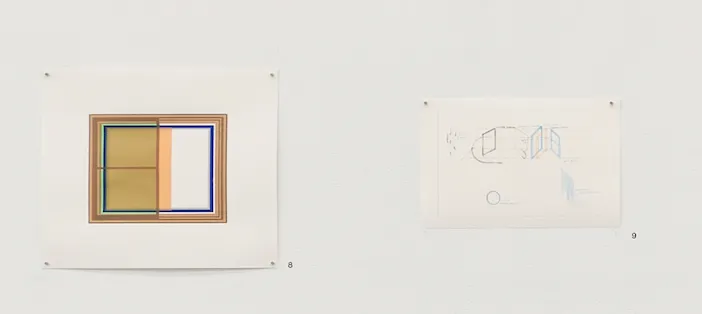
- Fig.2 Installation view at a83.
Left: clovisbaronian, cloche, 20” x 18”, silkscreen, 2023.
Right: Rui Itasaka, cloche and its surroundings, 11” x 17”, risograph, 2023.
Photo by Olympia.
板坂 私は《cloche and its surroundings》というコラージュドローイングをニューヨーク展のために描きました。このドローイングは、新しい窓を構成する素材と、その決断のきっかけとなった周辺のものによって構成されています。インスタレーション・ビューの外側に広がる関係性を表現しようとしました。
Itasaka I made a collage drawing called cloche and its surroundings for the New York show. This drawing comprises the materials that make up the new window and the surrounding objects that led to my decision. I tried to express the relationships that extend outside of the installation view.
クローヴィスバロニアン 《cloche》の設置後、窓枠に沿って、漆喰、木材、金属、ガラス、色彩が筋状に重なり合い、既存の素材と調和を生み出していることに気づいた時は嬉しかったです。この新旧を横断する印象的な表現をニューヨークの展示では、ドローイングで表現したいと考えました。その時にヒントとなったのは、磯崎のシルクスクリーンです。作品の特徴を伝えるためにあえて、パレットの色味を制限しました。また、今回、ニューヨーク展覧会の会場となったa83にあるプリントショップのオーナー、チバーヌーニーのオーウェンとクララも、私たちと一緒にさまざまなバリエーションと効果を探求してくれました。シルクスクリーンと透明インクを使い、各要素が重なり合って、微妙な色の混ざり合いが生まれるように試行錯誤しました。
clovisbaronian One of the pleasant surprises we discovered after installing the window on the Shinjuku White House was the arrangement it produced with the existing materials of the structure. Along the window jamb, a striated layering of plaster, wood, metal, glass, and color presented a cross-section of the old and new elements. We found this quality quite striking and wanted to somehow illustrate this aspect of layering in a drawing for the New York exhibition through a simple perspective. Taking cues from Isozaki’s silkscreen drawings, we relied on a limited palette of colors to convey the character of the work. We printed the drawing using a silkscreen and transparent inks, allowing each layered element to overlap and produce a subtle mixing of color. Owen and Clara at the a83 print shop worked with us to study different variations and their effects.
このプロジェクトを通して、磯崎や彼の作品について気づきはありましたか。/
Did you find anything from Isozaki and his work?
板坂 建築を学び始めて10年ちょっとの間、私にとって建築家・磯崎新は少し伝説めいた存在でしたが、《新宿ホワイトハウス》を起点に学ぶことで、彼の存在を地続きに感じるようになりました。教科書や建築論で示されてきた典型的な磯崎新とは異なり、彼が同世代のアーティストらと語り合う姿やそれによりできた空間の片鱗は、私たちの日々の姿と重なり興味を抱きました。
特に「プロセス・プランニング論」については、私自身の活動にとってかなり重要な考え方だと感じています。建築とは完成しないものだということを前提に捉えて設計する態度は、ここ十数年のことだと思っていたのですが、60年ほど前から議論されてきたことに勇気づけられました。
Itasaka For over a decade since I began studying architecture, Arata Isozaki has been a legendary figure to me. However, by getting to know the Shinjuku White House through this project, I have come to feel a sense of his presence adjoining to my world. Unlike the typical Arata Isozaki presented in textbooks and architectural theories, I became interested in how he talked with artists of his generation and the glimpses of space created as a result of their conversations, which overlapped with our daily lives.
Now, I believe Isozaki’s “process planning” is key concept for my work. I had previously thought that the attitude of designing on the premise that architecture is never finished was a recent idea in the last decade or so. I was encouraged to learn that this has been discussed for about 60 years.
クローヴィスバロニアン この往復書簡のプロジェクトと展覧会よりも前に、私たちは主に建築作品やドローイングを通して磯崎のことを知っていました。今回のプロジェクトを通して、彼の著作や建築作品を支える理論についてさらに調べる時間をもち、磯崎が建築という学問に対して疑念を抱き、同時に心酔していることに感銘を受けました。
また、長崎と広島の原爆投下という残虐行為や戦後の風景を目の当たりにした世代である磯崎の建築的探求の基礎を形成した背景を理解することは大変重要で、日本の仲間たちとさらに考察し、議論する必要があると感じました。
磯崎の芸術との関わりについて知ることも魅力的でした。キャリアの初期からネオ・ダダ・グループと関わりをもっていたことだけでなく、晩年まで芸術と文化に対して貪欲でした。磯崎は、執筆や建築物を通して、ときにパトロン、指導者、批評家、学者として、彼自身の独特な世界観を伝えようとしただけでなく、他者の声や作品も届けようとしていたと思います。彼の様々な実践に心から敬意を表します。
clovisbaronian Before this project and exhibition, we knew Isozaki primarily through his built work and drawings. Throughout this process, we have taken time to investigate further the writings of Isozaki and the theories underpinning his architectural work. We found his simultaneous suspicion of and infatuation with the discipline of architecture quite compelling.
Further understanding the context in which Isozaki formed the foundation of his architectural pursuits, stemming from a generation that had witnessed first-hand the atrocities of the bombings in Nagasaki and Hiroshima and a post-war landscape, was also valuable and something that warrants further reflection and discussion with our colleagues in Japan.
Learning more about Isozaki’s relationship to the arts was also fascinating - not only that he had been engaged with this community at such an early stage in his career, with the Neo-Dada group, but also that his voracious appetite for art and culture had continued until his final years. As a patron, mentor, critic, and scholar, he not only sought to convey his unique perspective of the world through his writing and buildings but also to bring outside voices to new audiences. We have great respect for his generosity in practice.
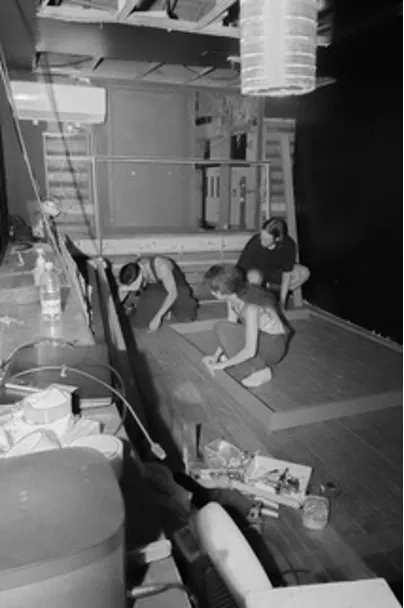
- Fig.3 Construction photo at the Shinjuku White House. Photo by Kei Murata.
半年間、海を隔てた相手と「往復書簡」をしてみてどうでしたか。/
How did you enjoy communicating with long distance?
板坂 当初は互いのバックグラウンドを詳しく知らない相手と制作をすることに戸惑いがありました。しかし、互いに違和感を抱くことがあった時に、その原因が言語的なことなのか、内面的なことにあるのか分からず、ないまぜになったままでコミュニケーションが続いていく過程が、日本語話者同士での共同制作と異なり、面白い経験でした。
「なんとかなる!」という謎の自信は、「作品をつくる」という明確な目標を一緒に目指していたから保てたのだと思います。言語の壁を言語で乗り越えるのは大変に難しく、情報がどんどん荒削りに、もしくは横滑りして、いつか諦めてしまいます。そこに「作品をつくる」という別のメディアがコミュニケーションツールとして加わることで、少しずつでも前に進むことができました。
フレームの色を青か緑で悩んだ時、初めは文字でそれぞれ思う理由を述べ合ったのですが、最終的には、他のものとの色や質のバランスなどを一緒に見ながら考慮して満場一致で「青」という選択をしました。それは、思想に優劣をつけたのではなく、どちらの選択をすることが作品のコンセプトにふさわしいか、という判断でした。
そういった判断を積み重ねながら、今回一緒に作品をつくってみて、私とクローヴィスバロニアンはどちらも状況を俯瞰的に見ているのかもしれないと感じました。普段、一人で設計していると、作品の要素が私個人の嗜好なのか、それとも作品固有のものなのか混同することがあります。今回チームとして取り組んだことで、それを意識的に区別することができ、作品と私の間に程よい距離を保てたことが心地よく新鮮でした。
Itasaka At first, we were at a loss to work with people who did not know each other well. When we felt uncomfortable with each other, we needed to continue talking without knowing whether the cause was a language problem or something internal. This process was a unique experience for me, unlike the collaborative work between Japanese speakers.
I think it was because we aimed at the explicit goal of making a work of art that we could maintain an unfounded confidence that "It will work out!” It is very challenging to overcome language barriers with language, and the information becomes rougher or sloppy, and one day you end up giving up. But the intervention of another medium, creating artwork as a communication tool, allowed us to move forward, even if only gradually.
When choosing the frame color in blue or green, we initially discussed why we each thought it should be blue or green. Ultimately, we unanimously decided on "blue" after looking at the balance of color and quality with the other items. It was not a judgment of superiority or inferiority of ideas but rather a decision on which choice was more appropriate for our work.
After working together on this project, I realized we both share a bird's eye view of the situation. When I design alone, I sometimes get confused about whether the elements of a work are my personal preferences or unique to the work. By working as a team this time, I could consciously distinguish between the two, and it was refreshing to feel a sense of distance between the work and myself.
クローヴィスバロニアン この往復書簡のプロジェクトは、挑戦的でやりがいがありました。コラボレーションは、同僚やコンサルタント、施主、施工者と共に働くという意味で、建築を設計するうえでは一般的な手法ですが、他の建築家と共にこのような実践に携わるのは初めてのことでした。プロジェクトの初期段階では、空間的にも時間的にも距離があるため、独特の困難がありましたが、板坂さんと一緒に仕事ができて本当によかったです。
私たちにとって、設計段階で《新宿ホワイトハウス》を訪れることができないのは難しいことでした。というもの、このプロジェクトを通して既存の構造に関わることを望んでいたからです。板坂さんが建物の状況を記録し確認してくれたことは、とても有り難かったです。
最終的にこのプロジェクトが成功したと言えるのは、板坂さんも私たちも、自分たちだけではこのような作品をつくれなかったと思うからです。薄い木片を埋めるなど、当初は作品制作におけるエラーとしか思えなかった要素を作品に付加価値を与えるセレンディピティな瞬間として受け入れる姿勢や、「ブラッシュアップ」と呼んでいるデザインに対する板坂さんの考え方や行為に私たちはとても刺激されました。
おそらく、最も楽しいコミュニケーションの形は、現場で生まれたと思います。板坂さんとは対話だけでなく、スケッチ(そして多くの身振り手振り)を通して、直接会話しながらプロジェクトを進め、設置することができました。その点では、距離こそが最大のチャレンジだったかもしれません。
clovisbaronian The project was both a challenging and rewarding experience. Collaboration as a design methodology is intrinsic to architecture - working alongside colleagues, consultants, clients, and builders - but we had never engaged in this practice mode alongside another architect before. While the distance, both in space and time, presented unique challenges during the early stages of the project, our experience corresponding and working with Itasaka-san throughout the process was a joy.
For us, it was difficult not being able to visit the White House during the design phase, as we wanted the project to engage with the existing conditions of the structure. Thankfully, Itasaka-san was very helpful in documenting and assessing the conditions of the White House.
The final project is successful in the fact that neither Itasaka-san nor ourselves would have made a work like this on our own. Her ideas of design as an act of “brush up” inspired us, as did her embrace of elements that we initially saw as errors in the execution of the work (such as wood shims) instead as serendipitous moments that added value to the piece.
Perhaps the most enjoyable form of correspondence came during the on-site installation of the work itself. We could converse directly with Itasaka-san not just through dialogue but also through sketching (and many hand gestures) as we developed and installed the project. In that respect, distance is the greatest challenge.
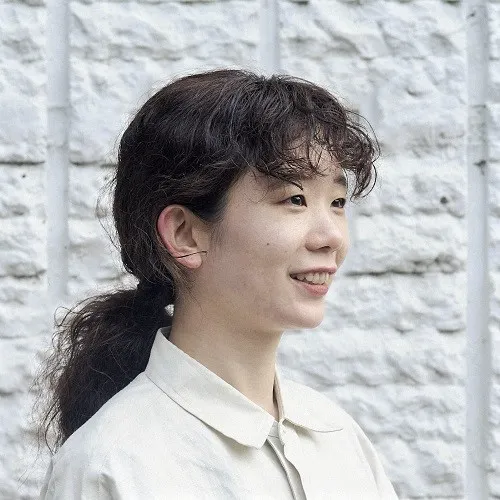
- 板坂留五/Rui Itasaka
- 1993年生まれ。2016年東京藝術大学主席卒業。2018年同大学院を修了後、《半麦ハット》をきっかけに独立。Architects of the Year 2019入選、Under 35 Architects exhibition 2021 Gold Medal など受賞。ほか、パン屋の改修《TANNERAUM》、アートブック『半麦ハットから』の出版、アパートの改修《角部屋の眺め》など。設計を通して、大きさに関わらず、建築のもたらす「気づき」を扱いたいと考えている。 Born in 1993, graduated from Tokyo University of Arts in 2018, became independent with Hanmugi Hat. Received awards such as Architects of the Year 2019 Honorable Mention, Under 35 Architects exhibition 2021 Gold Medal, etc. Other projects include the bakery renovation TANNERAUM, and the publication of an art book, Through Hanmugi Hat, and renovation of apartment Scenes of A Corner room. Through design, regardless of size, I hope to deal with the “Awareness” that architecture brings.
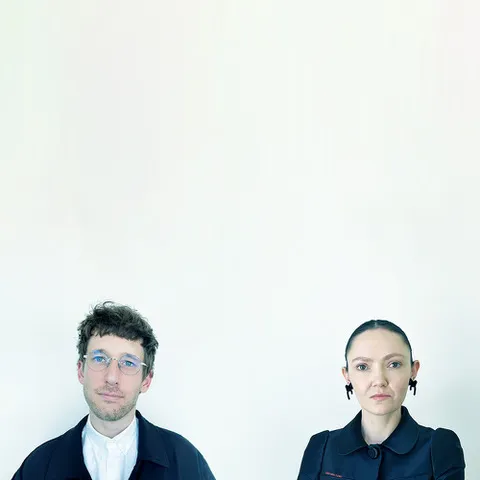
- クローヴィスバロニアン/clovisbaronian
- クローヴィスバロニアンは、ジョジーナ・バロニアンとサム・クローヴィスが主宰する、カリフォルニアとテキサスを拠点とする建築事務所である。作品をつうじて、風土と美学の相互関係を探求している。 ジョジーナ・バロニアンは、1990年ニュージーランド生まれ。ニューヨーク州登録建築士、ライス大学建築学科助教。プリンストン大学で建築学修士号を取得後、SANAAと石上純也の事務所を経て、独立。ラファージュ・ホルシム財団持続可能建設次世代グローバル賞、ハワード・クロスビー・バトラー・トラベリング・フェローシップなどを取得するなど、国際的に高く評価されている。最近ではオハイオ州立大学ノウルトン建築学校のハワード・E・ルフェーヴル'29 エマージング・プラクティショナー・フェロー(2022-23)を務めた。 サム・クローヴィスは、1991年アメリカ生まれ。カリフォルニア州登録建築士。プリンストン大学で建築学修士号を、カリフォルニア州立工科大学サンルイスオビスポ校で建築学士号を取得。研究や設計作品は、ソウル建築都市ビエンナーレやヴァン・デル・プラス・ギャラリーなどで、展示されている。プリンストン大学、カリフォルニア州立工科大学ポモナ校、オハイオ州立大学などで教鞭をとり、現在はヒューストン大学で教鞭をとる。 clovisbaronian is an architecture practice based in California and Texas lead by Georgina Baronian and Sam Clovis. Their work explores the interrelation of climate and aesthetics. Georgina Baronian (New Zealand, 1990) is a licensed architect in the State of New York and Assistant Professor of Architecture at Rice University. Prior to establishing an independent practice, Georgina worked for the offices of SANAA and Junya Ishigami. Georgina has been internationally recognized for her work with the LafargeHolcim Foundation for Sustainable Construction Next Generation Global Prize, the Howard Crosby Butler Traveling Fellowship, and was recently the 2022-23 Howard E. LeFevre ’29 Emerging Practitioner Fellow at the Knowlton School of Architecture. She received her Master of Architecture from Princeton University. Sam Clovis (USA, 1991) received his Master of Architecture from Princeton University and Bachelor of Architecture from Cal Poly San Luis Obispo. His research and design work has been widely exhibited, including at the Seoul Biennale for Architecture and Urbanism and the Van der Plas Gallery. Sam has previously held academic positions at Princeton University, Cal Poly Pomona, The Ohio State University, and currently teaches at the University of Houston. He is a licensed architect in the State of California.
Postscript#3 Korogaro Association/Kengo Sato Architecture Office ⇄ Departamento del Distrito < 前の記事