

F2-2-3
Part2 往復書簡/Correspondence
#3 Korogaro Association/Kengo Sato Architecture Office ⇄ Departamento del Distrito
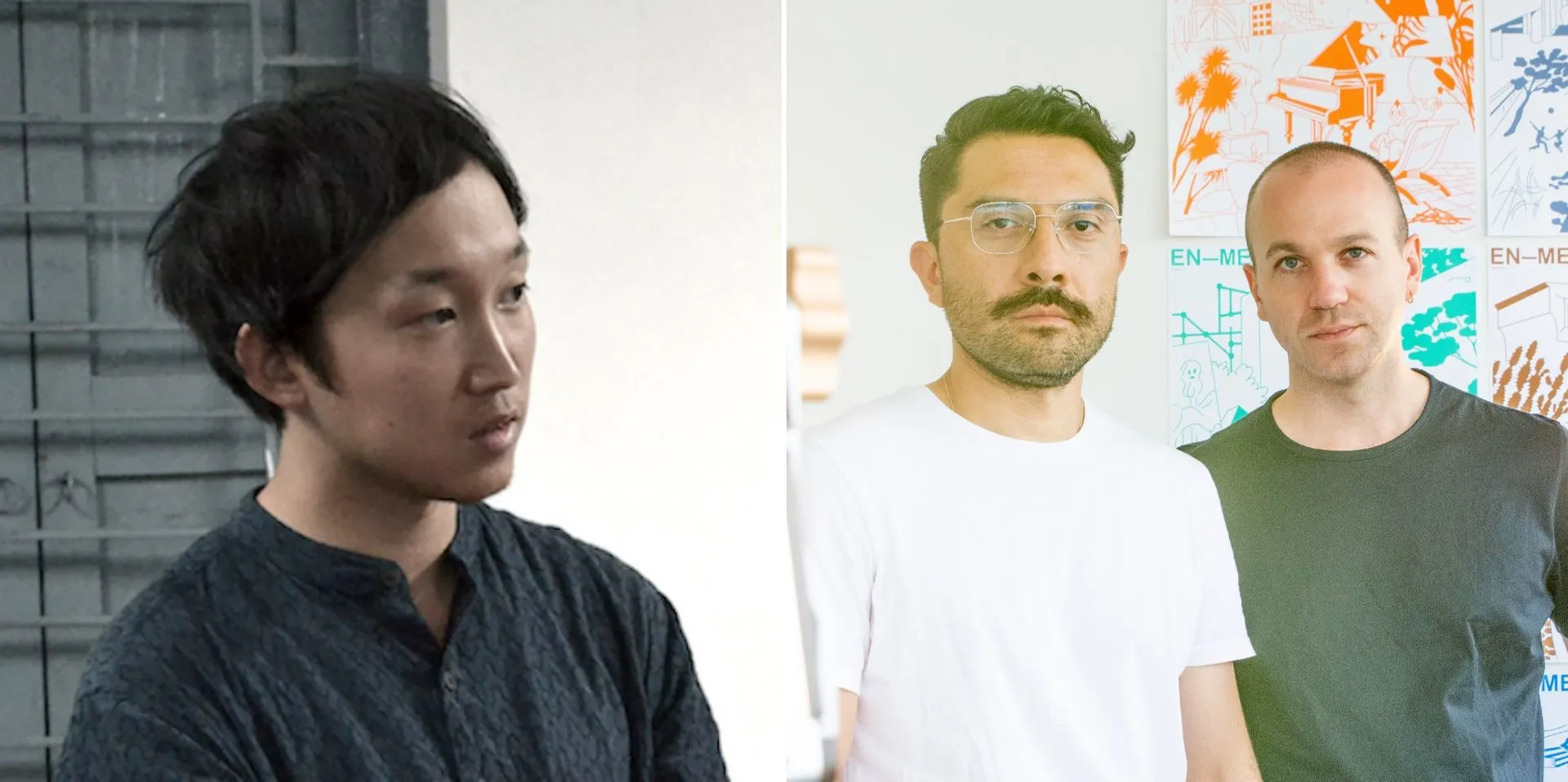
4 pairs of Japanese and North American architects exchanged texts and images before opening the exhibition at Shinjuku White House (currently, members-only art space “WHITEHOUSE”) and “a83” in New York fall 2023. Each pair shares conversations on a document-sharing file online between them and processes to make the installation together. #3 is a correspondence between Fukushima-based architect Kengo Sato and the Mexico City-based design office Departamento del Distrito. (For more information, please see #0.)
-
Contents
-
230503/21:00(JST)/Kengo Sato
How about starting the conversation by linking the two topics, pragmatism and Arata Isozaki?
I think it is very easy to connect pragmatism with his stance. The fact that post-modernism begins precisely from the principle of non-centeredness, the absence of center, also seems to reinforce the above logic. Incidentally, “non-center” and “absence of center” may strictly speaking have different meanings, but I dare to use them in a mixed-up way.
It is, of course, extremely difficult to answer the question, “Who is Arata Isozaki?” However, I would like to consider the fact that he cleverly imitated elements from all over the world, regardless of nationality, into his architectural designs, and that he himself came out of a non-central region of Japan (=Kyushu region). This also leads to an important consideration of the fact that most of the members of the group “Neo-Dada Organizers,” which used Shinjuku White House at that time, were, like Isozaki, from Oita prefecture of Kyushu.
I am also vaguely thinking that through thinking about the above, we can link this to considering the possibility of a “non-center” that is slightly removed from the center, and not limited to Japan. In other words, I believe that I am talking about our creative potential, which seems to stay in the non-center or try to keep the non-center within ourselves.
230503/18:05(CST)/Nathan & Francisco, Departamento del Distrito
Hi Kengo,
Thanks for writing.
We like taking up the topic of pragmatism as a starting point.
Perhaps in the coming weeks, we can look at pragmatism as both a philosophical movement and a practical stance towards the profession.
Pragmatism can serve as one lens through which to understand the work of Isozaki, and can also serve as a way to integrate our independent practices and voices into the conversation.
A few Isozaki projects come up as possible references:
(1) Electric Labyrinth (14th Triennale di Milano [exhibition unrealized], Italy, 1968)
I was put in charge of a corner at the fourteenth Milan Triennale. My project, which was called “Electric Labyrinth,” used light, projections, sound and music to involve the visitor in a technologically created environment. In the display, ghost-figures from the Edo period of Japanese history (1600-1867) overlapped with the ruins of Hiroshima and the destruction of the city of the future in what amounted to a criticism of modern urban planning for doing no more than painting rosy, Utopian pictures.
Arata Isozaki, “Reduction to the Blank: Method, Manner,” (1970)
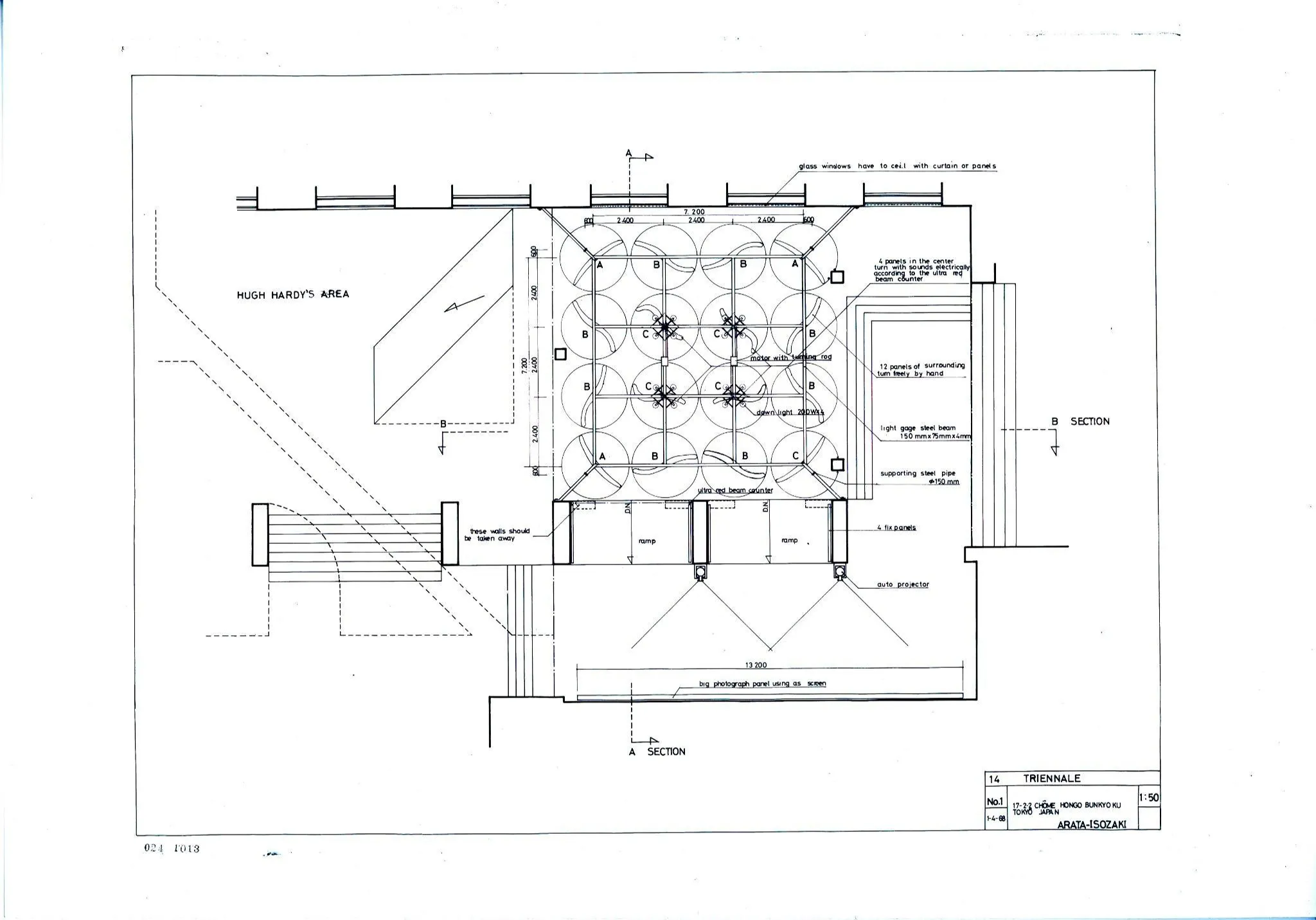
- The plan of Electric Labyrinth
©︎Estate of Arata Isozaki
(2) Palladium Club (New York, U.S.A. 1983-85)
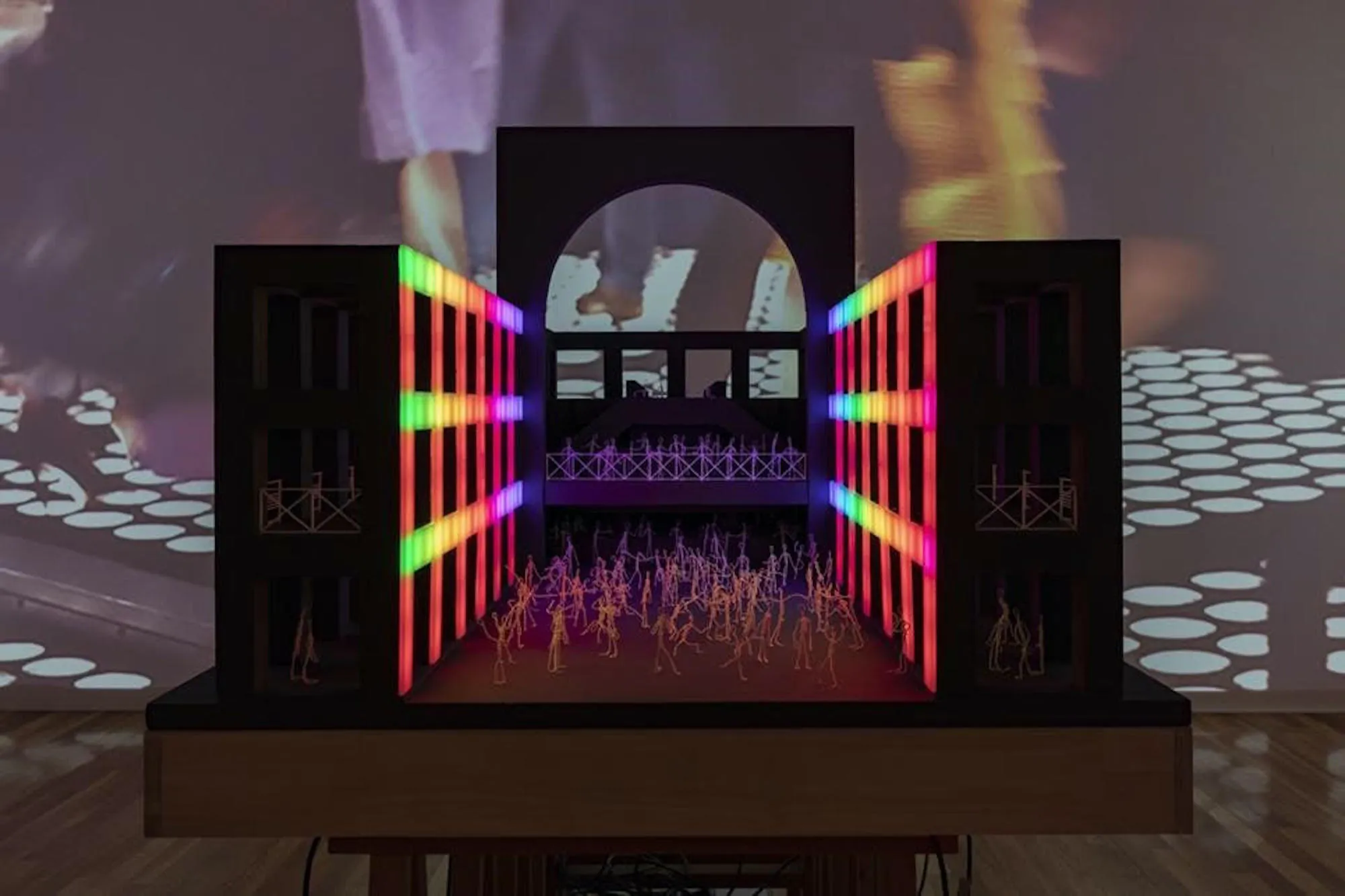
- Model of Palladium Club, made for the exhibition “Arata Isozaki: Third Place” (Oita Art Museum, 2019).
Photo: Takafumi Kubo, Courtesy of Oita Art Museum.
(3) Arai House (Responsive House) Project (Fukuoka, Japan, 1968-1969)
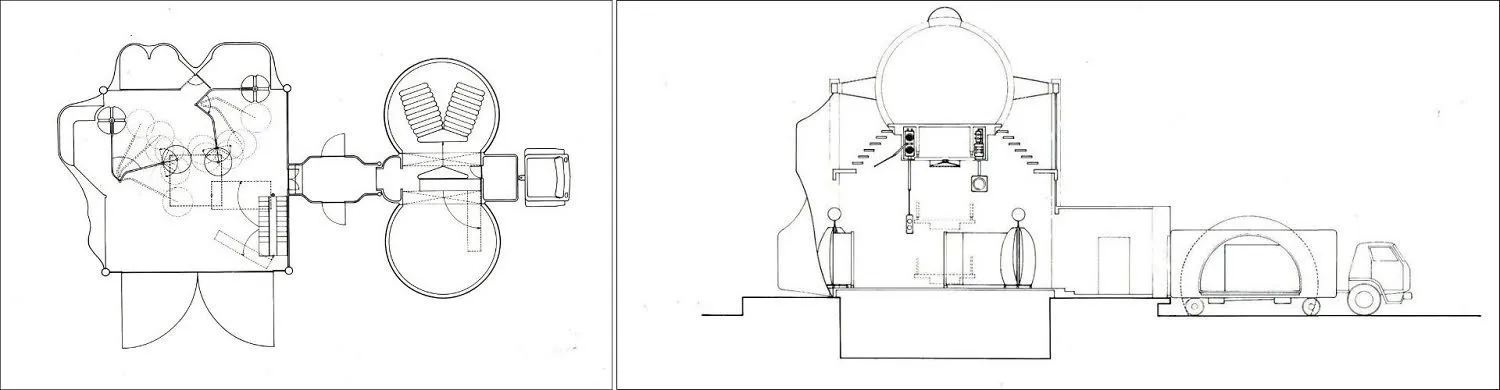
- The plan and cross section of Arai House (Responsive House).
©︎Estate of Arata Isozaki
Also, on a more practical level, we are in the process of constructing a digital and physical model of Shinjuku White House.
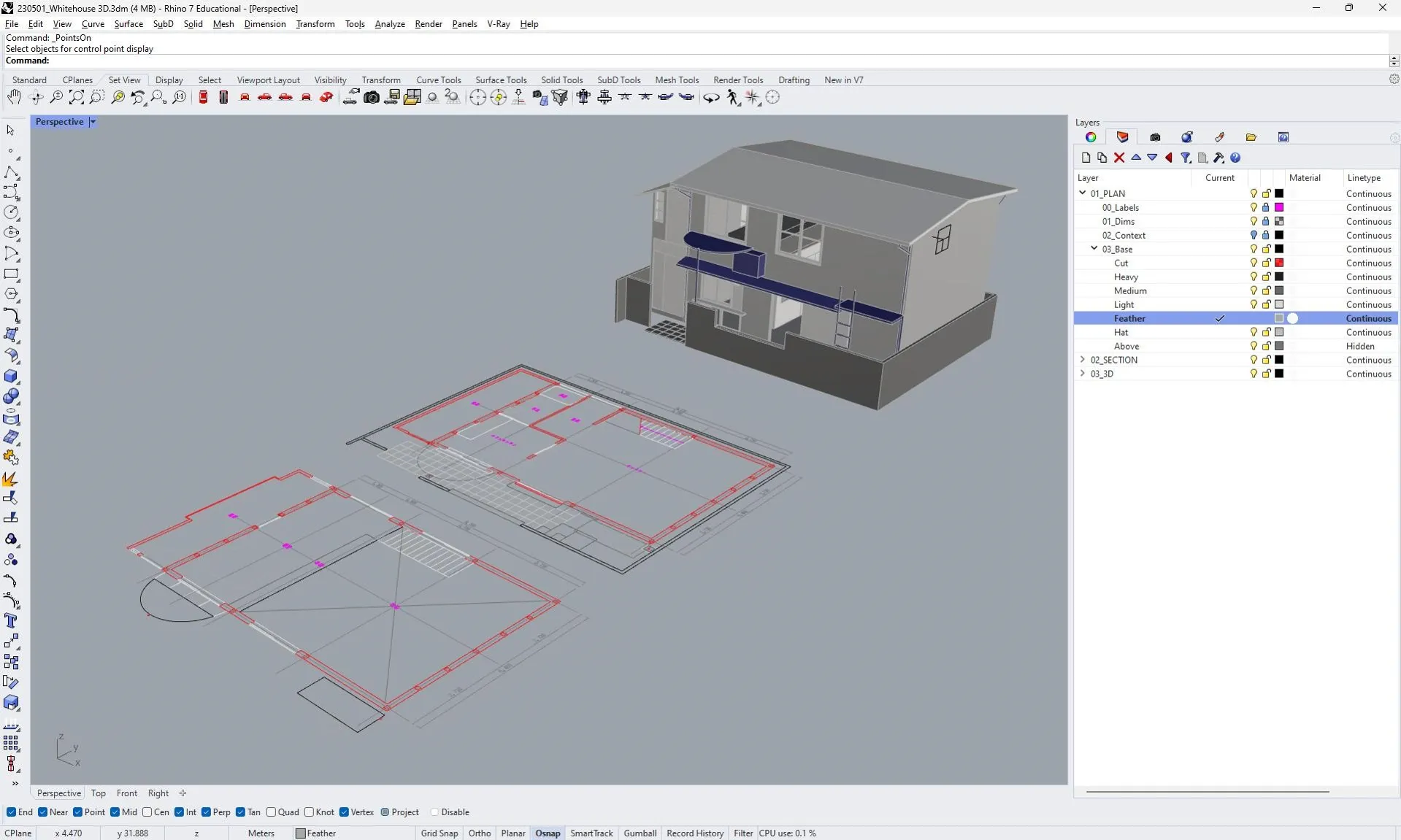
- Digital model of Shinjuku White House, in process by Departamento del Distrito.
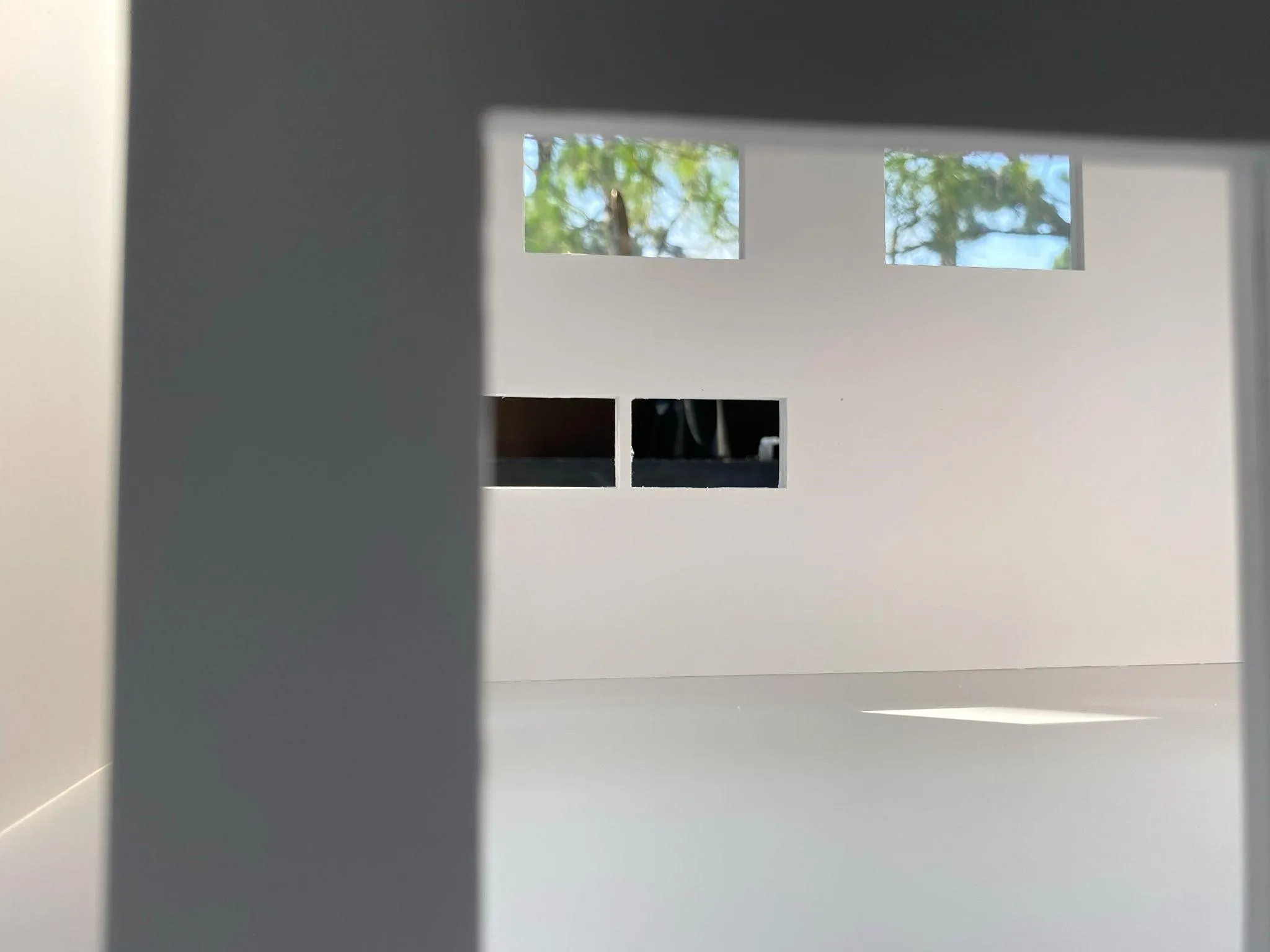
- Physical model of Shinjuku White House, in process by Departamento del Distrito.
Talk to you soon,
Nathan and Francisco
PS. Possible Shinjuku White House sites:
- Furniture
- Wall
- Window
230504/10:00(JST)/Kengo Sato
Thank you very much for your reply.
Pragmatism serves as one of the lenses for understanding Isozaki’s work, and also as a way to integrate our independent practices and voices into our conversations.
I totally agree with what you said about “pragmatism.” There is great potential in your words. At the same time, we may differ in interpreting the term “playful” in our exhibition title.
Thank you for mentioning Isozaki’s projects.
I would like to mention Deme and Deku at the 1970 Osaka Expo. For the Expo, Kenzo Tange and URTEC designed the structure of the large roof of the Festival Plaza at the Symbol Zone’s core, and Isozaki designed Deme and Deku, the two large robots under its large roof. Also, I think it is important that one avant-garde artist group, Gutai, who was in the same generation as Neo-Dada Organizers, danced and performed in this plaza.
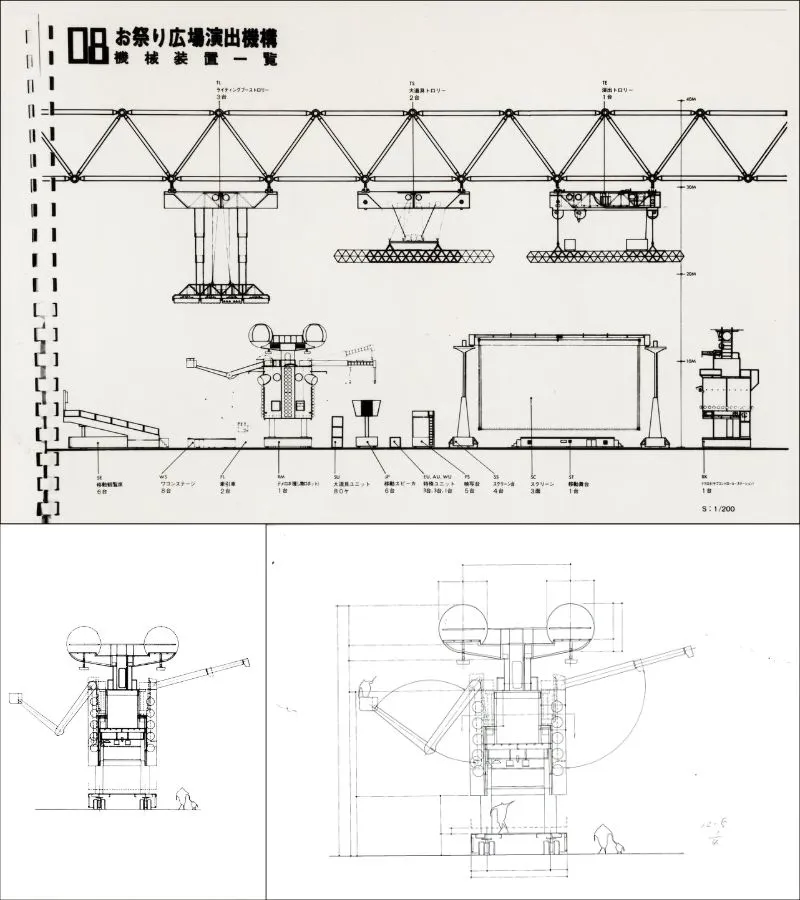
- Deme and Deku for the Expo 1970 in Osaka
©︎Estate of Arata Isozaki
Additionally, what attracts me is that Isozaki consistently held the phrase “housing is not architecture” and “architects should not design houses.”
Related to this, I am interested in the exhibition in 2014 titled “Legends of Postwar Japanese Housing: Provocative Houses, Introspective Houses.” It featured 16 housing projects by 16 prominent post-war Japanese architects, including Kazuo Shinohara and Kenzo Tange, Toyo Ito. Among them, Isozaki also participated, and surprisingly Shinjuku White House was exhibited there.
I think this is a very clever case. Because even though Shinjuku White House has the word “house,” it was not essentially a residence. It may have had a residential function, but it is considered that the function of the house was dismantled and collapsed. Isozaki exhibited it as his own “representative” housing work. I think there was a big irony here, and I think that this is also where the significance of the existence of Shinjuku White House lies.
In our exhibition this time, it may be possible to think about the fictionalness of “housing architecture” that Shinjuku White House is pregnant with. I also think that this will be combined with the concept of the simulation. I think that the concepts of simulation and “Simulacres” are important keywords in Isozaki’s theory of city and architecture. I think that this is deeply rooted in the projects by him, which we are currently discussing.
Based on these perspectives, we may be able to think about what elements (furniture, wall, window, etc) of Shinjuku White House we will use and what kind of design work we will develop.
230515/20:50(CST)/Nathan & Francisco, Departamento del Distrito
Hi Kengo,
Good evening.
The semester has just finished here. We are looking forward to working on the project for Shinjuku White House project with you over the summer.
Performance, encounter, and chance—mediated through some sort of technological apparatus or device—are themes that run through several of the Isozaki projects that have been shared recently: the way in which Deme and Deku transformed Festival Plaza into a “space of random encounters”; the technological interior retrofit of Palladium Club that was designed to “shower the human five senses with a combination of images, lights, and sounds”; or the way in which the rotating panels in Electric Labyrinth worked to implicate the exhibition-goer in the curatorial display and positioning of material.
These references, which can be understood as designed infrastructures that support human activity and interaction, confirm our interest in Shinjuku White House service spaces—the kitchen, bathroom, and storage areas that function behind the scenes but are essential to the life of the main, double-height living area.
We absolutely agree that the inclusion of Shinjuku White House in Legends of Postwar Japanese Housing is an important detail. It’s tempting to read the selection through a social and political lens. From our perspective, Shinjuku White House was not designed around a traditional notion of the nuclear family, nor for a particular social-economic class. It is a form of housing, as its inclusion in the exhibition argues, just not a normative one. It is a house that, like the other references mentioned, supports new forms of performance, encounter, and possibility within its walls.
We have compiled additional images of the service spaces. The photographs of the kitchen and bathroom can be found at the following sites and the image of the bathroom intervention can be found here.
And the base model is more-or-less complete:
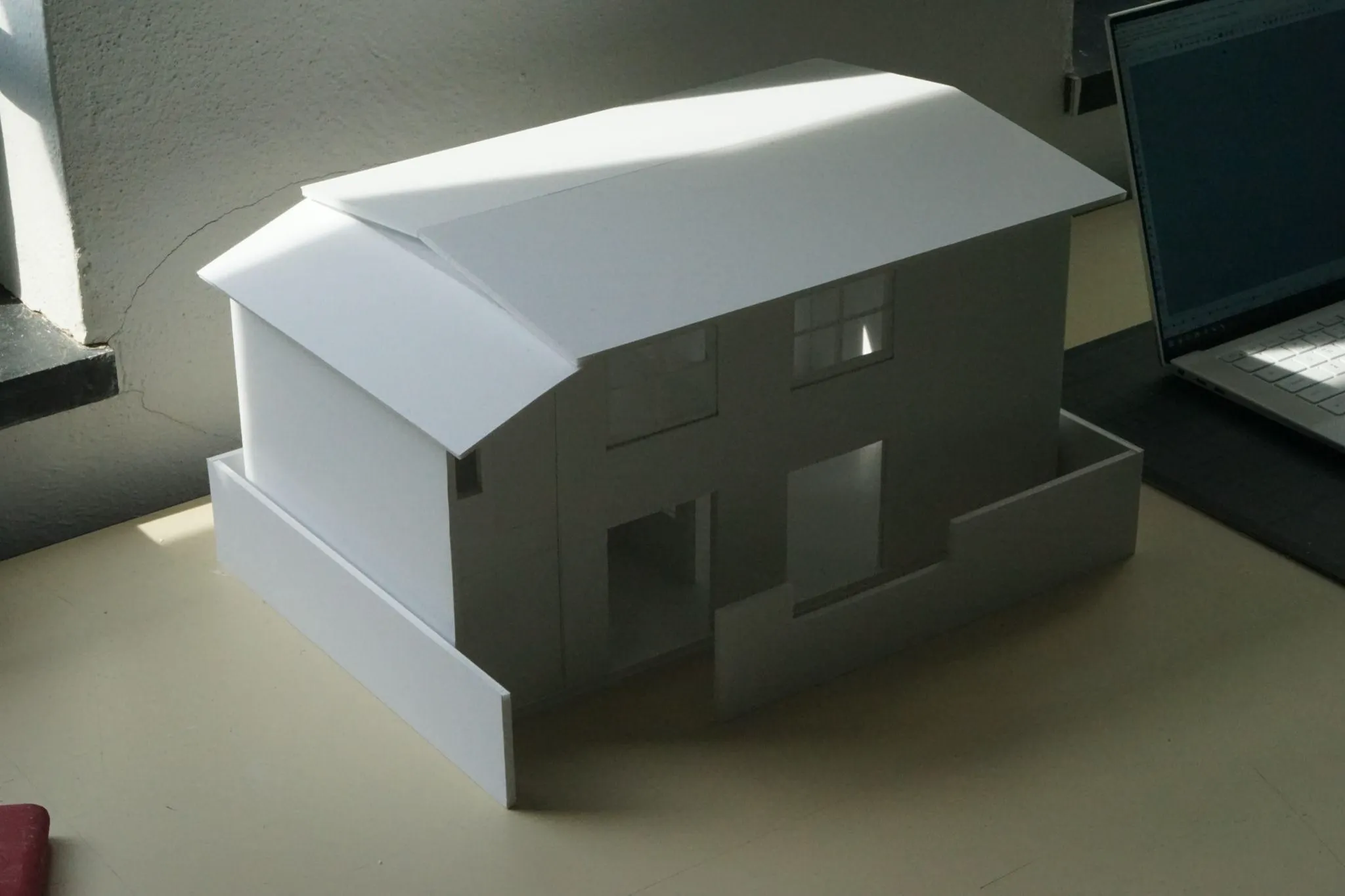
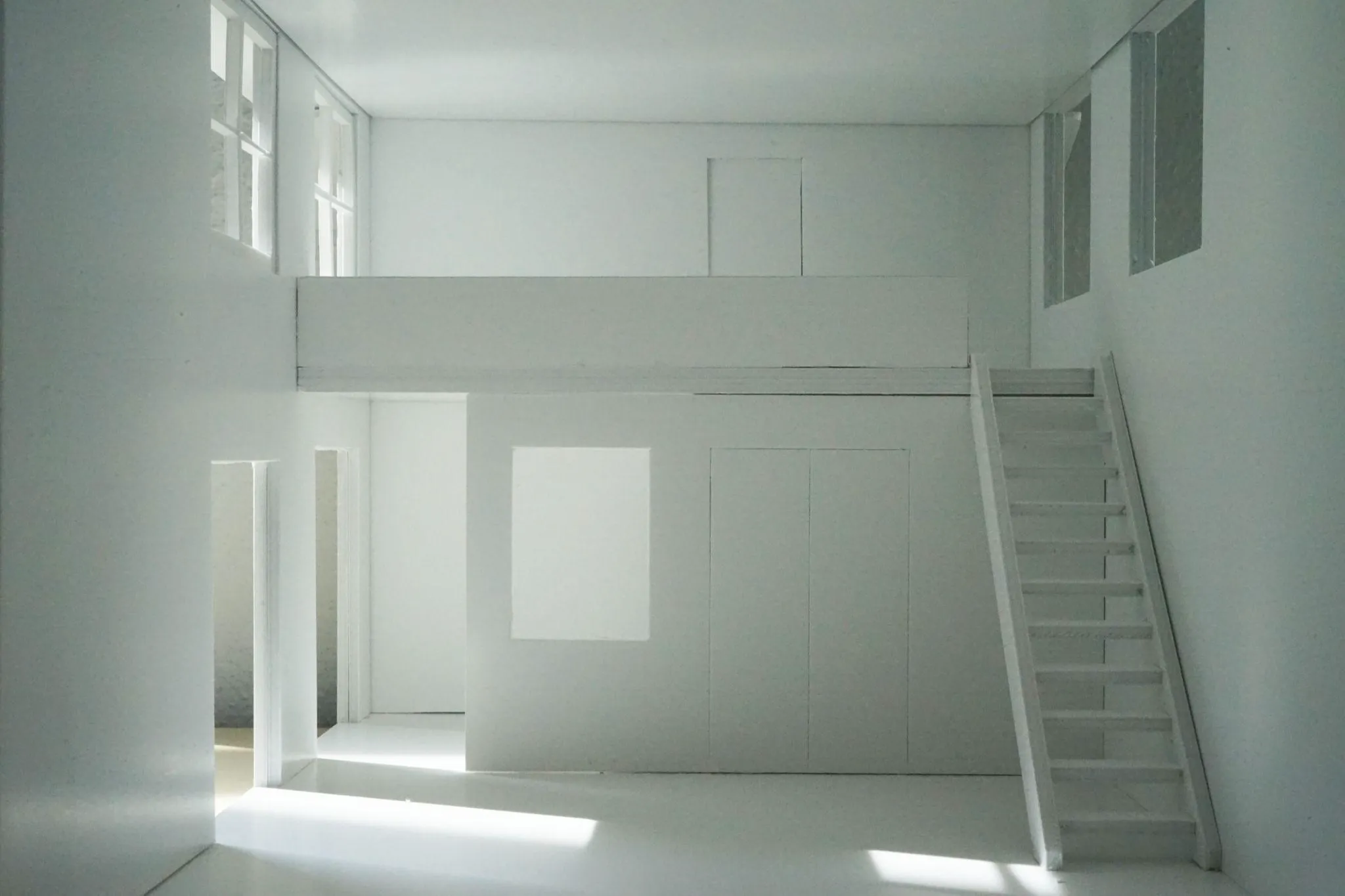
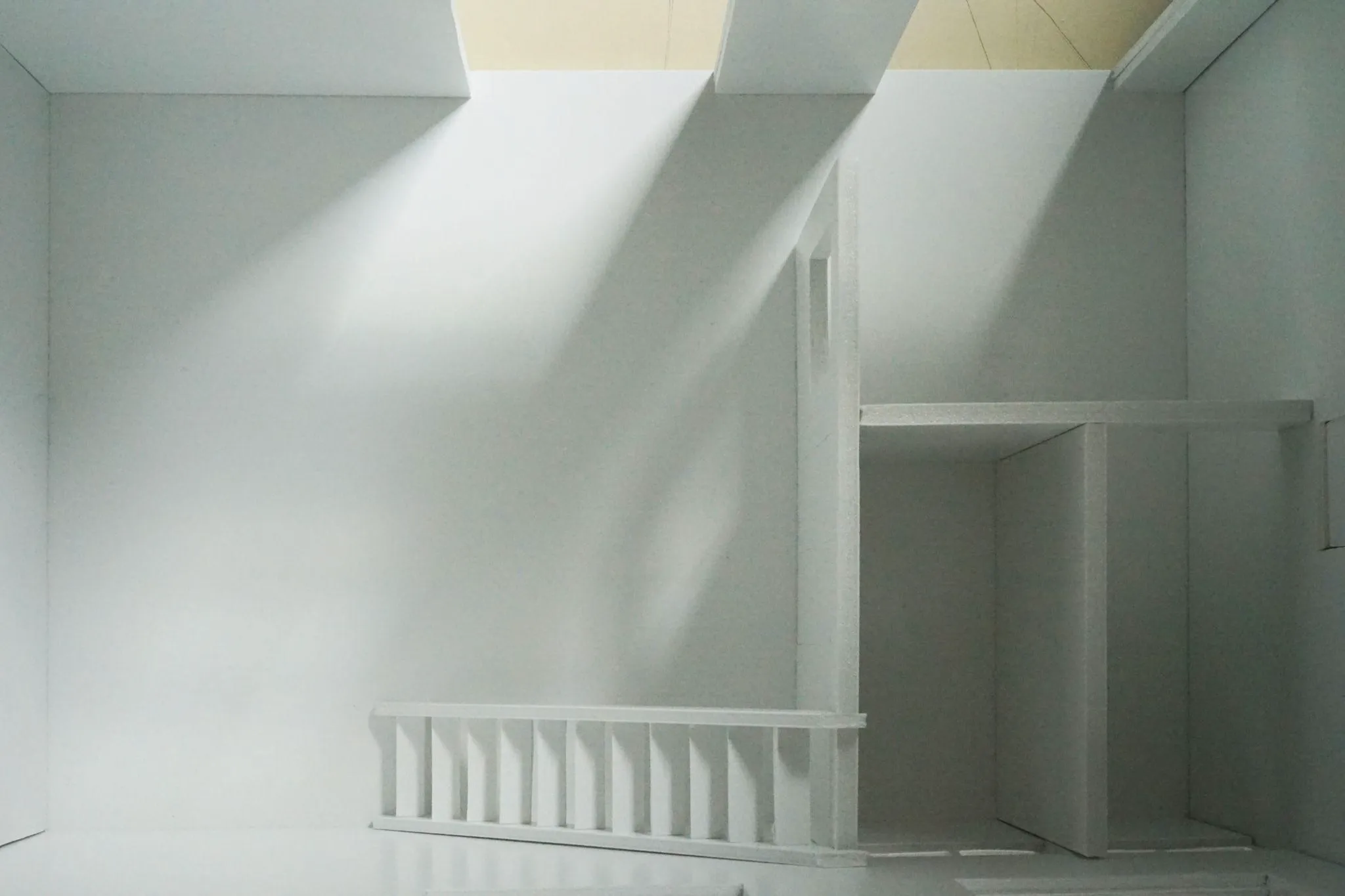
- Physical model of Shinjuku White House by Departamento del Distrito.
A few context questions:
(1) How have Shinjuku White House service spaces evolved over the years? Have they been adapted and renovated to support the changing needs and programs of the site?
(2) What can be seen through the storage and bathroom windows? Is the context on the north side of the site visible?
(3) Do the events at WHITEHOUSE ever activate or “spill-out” onto the street? How does the current gallery relate to its surrounding urban context?
Talk soon,
Nathan and Francisco
230526/16:25(CST)/Nathan & Francisco, Departamento del Distrito
Hi Kengo,
Greetings from Mexico City.
Ahead of our group meeting this week, we’d like to share a recent installation idea: a mobile support wall.
This intervention is part infrastructure, part furniture. Building off of ideas from our previous post, the mobile support wall functions as a literal and conceptual extension of Shinjuku White House service spaces.
Stored in the on-site closet while not in use, the project can be rolled out at specific moments in time: to act as scaffolding during installations in the main gallery space; to provide an additional display surface when the existing wall space is insufficient; or to extend WHITEHOUSE program onto the side street, where it might function as a beacon, bar table, or DJ booth.
For us, there is a connection to be made between this proposal and Isozaki’s Deme and Deku project at the 1970 Osaka Expo. The drawings and images in the Soft Architecture publication (KenchikuBunka, Jan 1970) are absolutely incredible.
The design of the support wall could take on a radical, even abrasive quality — asserting itself as a foreign element that reshapes the social and environmental qualities of WHITEHOUSE. We’re reminded of this quote from Isozaki’s text “Style in Ruins: Time and Space = Time and History” from 1980:
“I […] believe that new buildings should stimulate the creation of new contexts in their surroundings. This is why my buildings assume either an aggressive or a defensive posture in relation to their settings. The same attitude pervades my architectural criticism. In other words, my doctrine of maniera is anti-contextualist. From the outset, my buildings are expected to generate discord with their settings.”
The Island Nation Aesthetic, Academy Editions, 1996
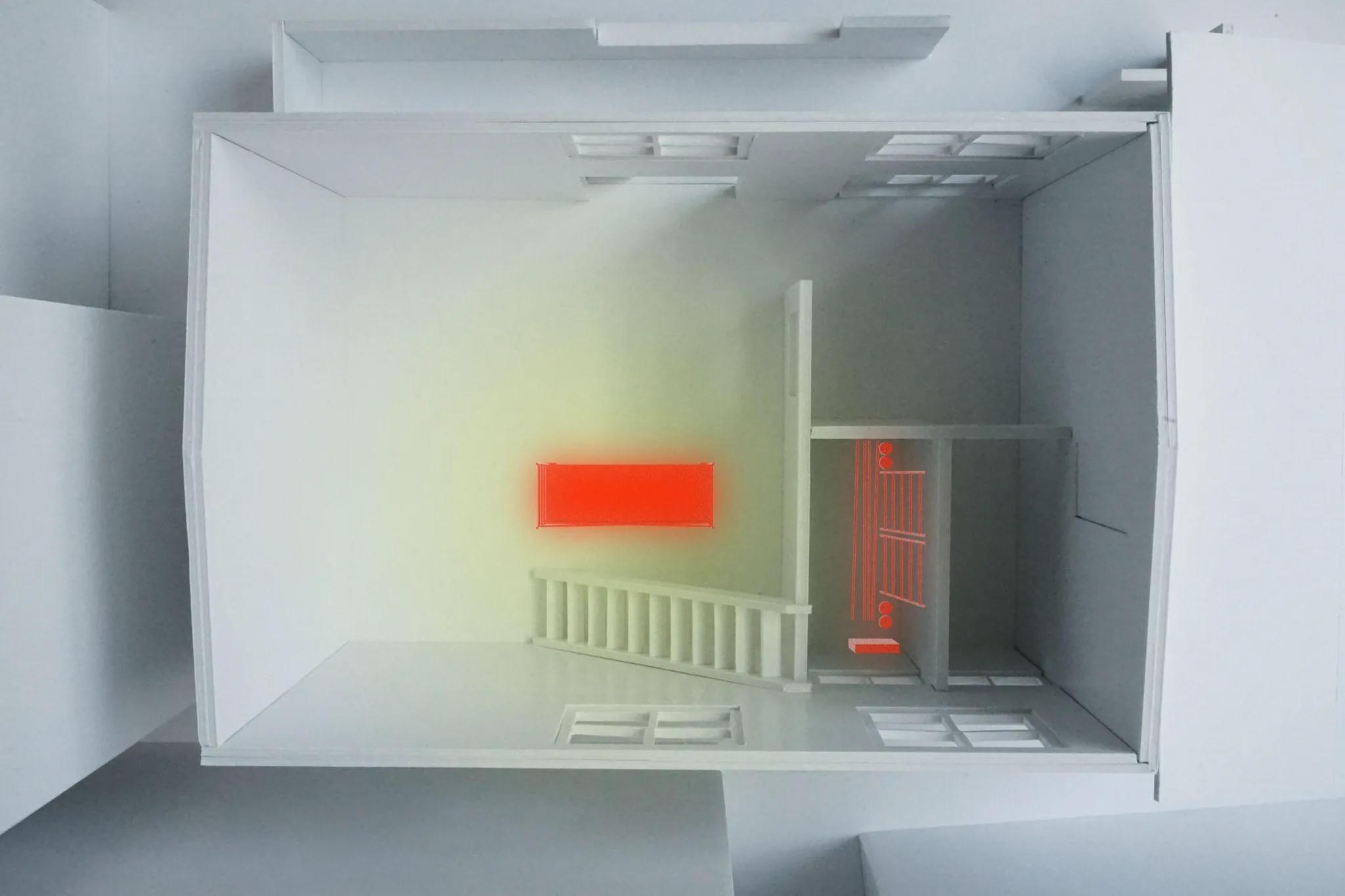
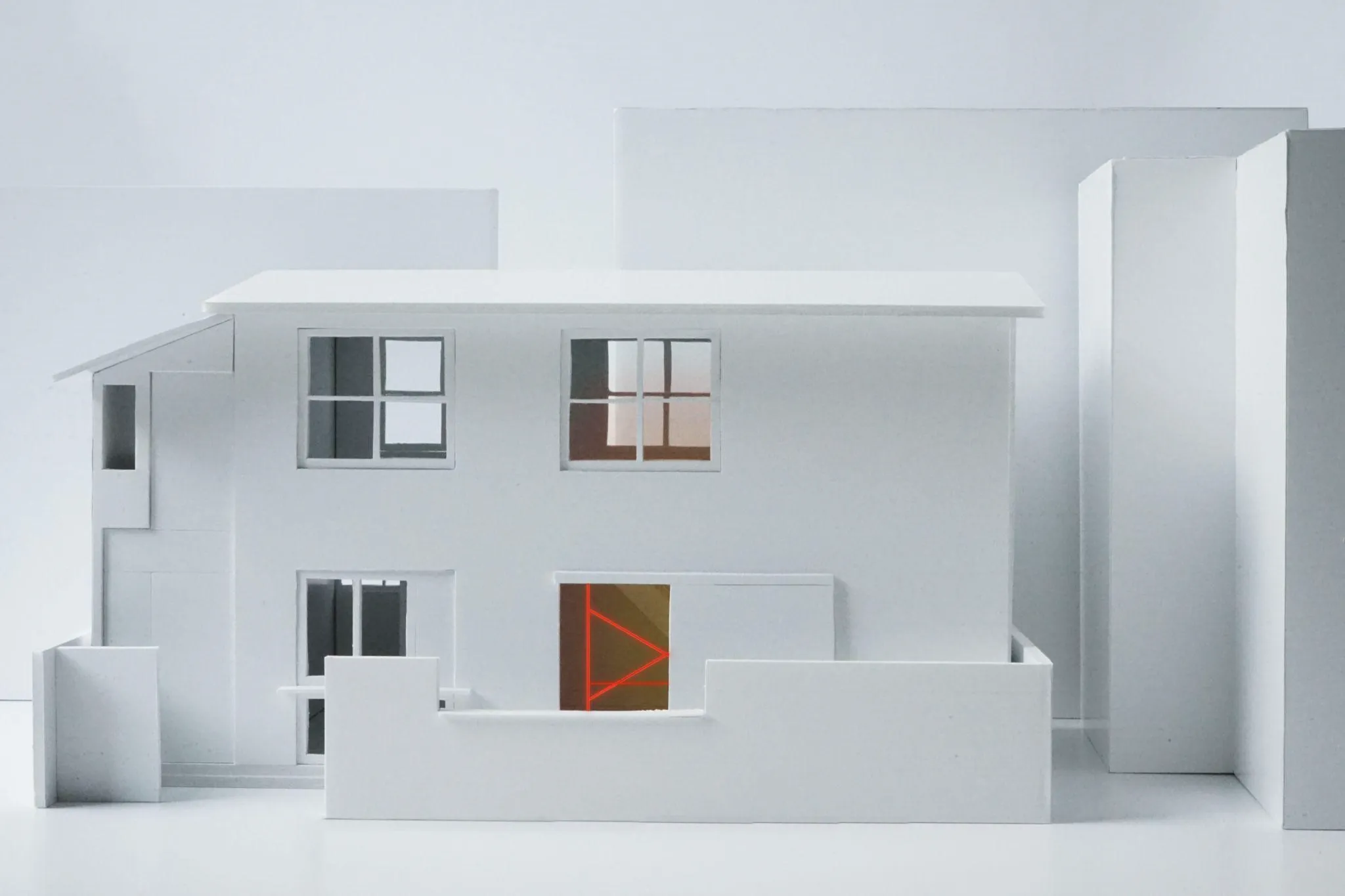
- Schematic proposal by Departamento del Distrito.
Looking forward to discussing further with you.
All best,
Nathan and Francisco
230531/21:30(JST)/Kengo Sato
I am very sorry for the late reply.
First of all, I strongly agree with you on the infrastructure of this house. I think that at that time, Isozaki presented performance and happening art as new architectural themes and spatial concepts. If you look at it from the other side, I believe that focusing on infrastructure as the existence that supports this concept will also lead to focusing on the grounds that architecture remains a physical object.
I’ll try to answer the question you asked me.
1. Changes in Shinjuku White House’s Service Space
Looking at the below, a warehouse was built next to the service space in the early days, but it seems that the service space itself has not changed much.
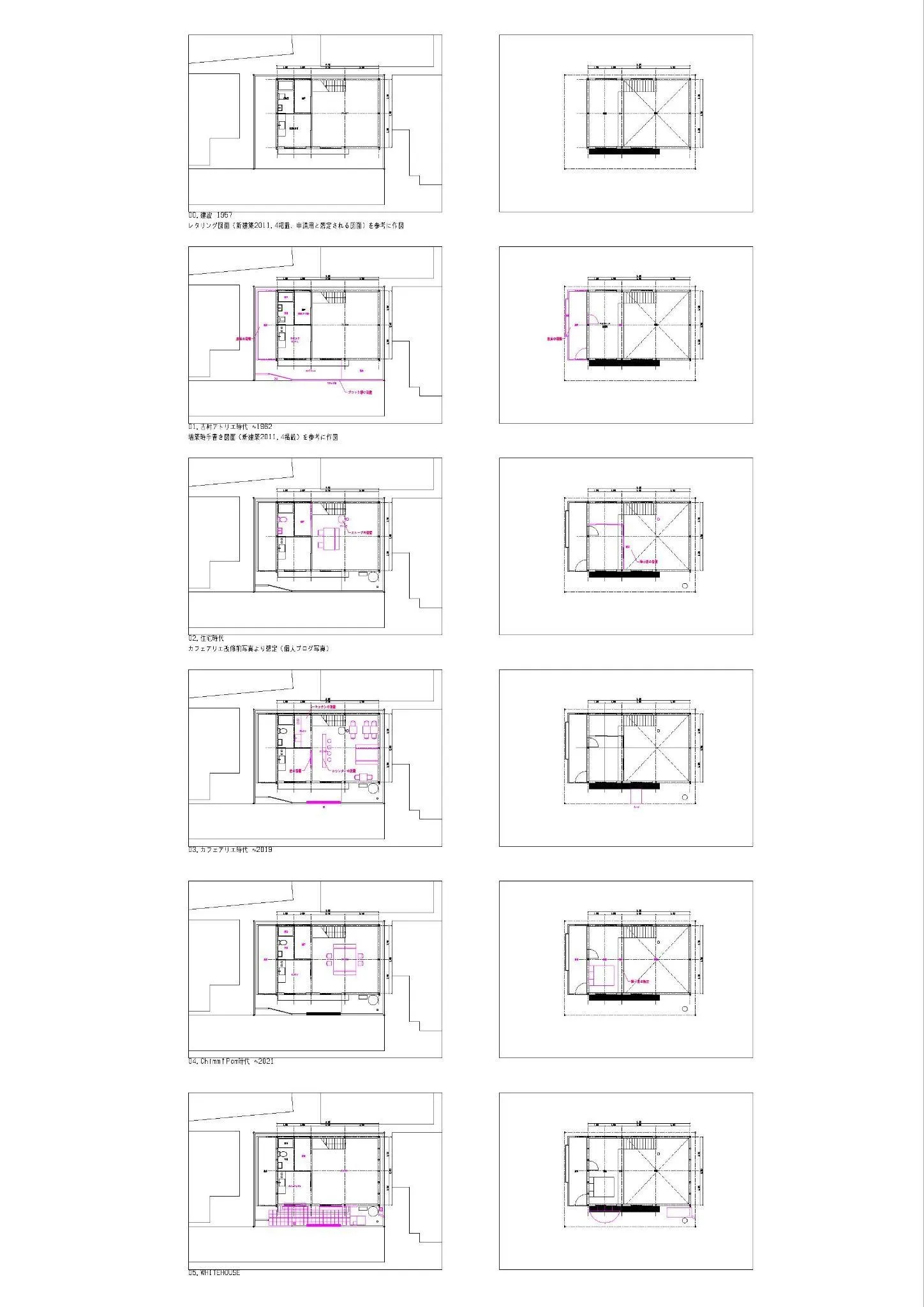
- Chronological plan. Courtesy of GROUP
2. What can you see from the bathroom window?
Sorry, I don’t remember exactly, but basically, there should be a concrete block wall right there. And behind that, I think there’s a house or apartment wall.
I visited Shinjuku White House the other day. I am sharing some photos below.
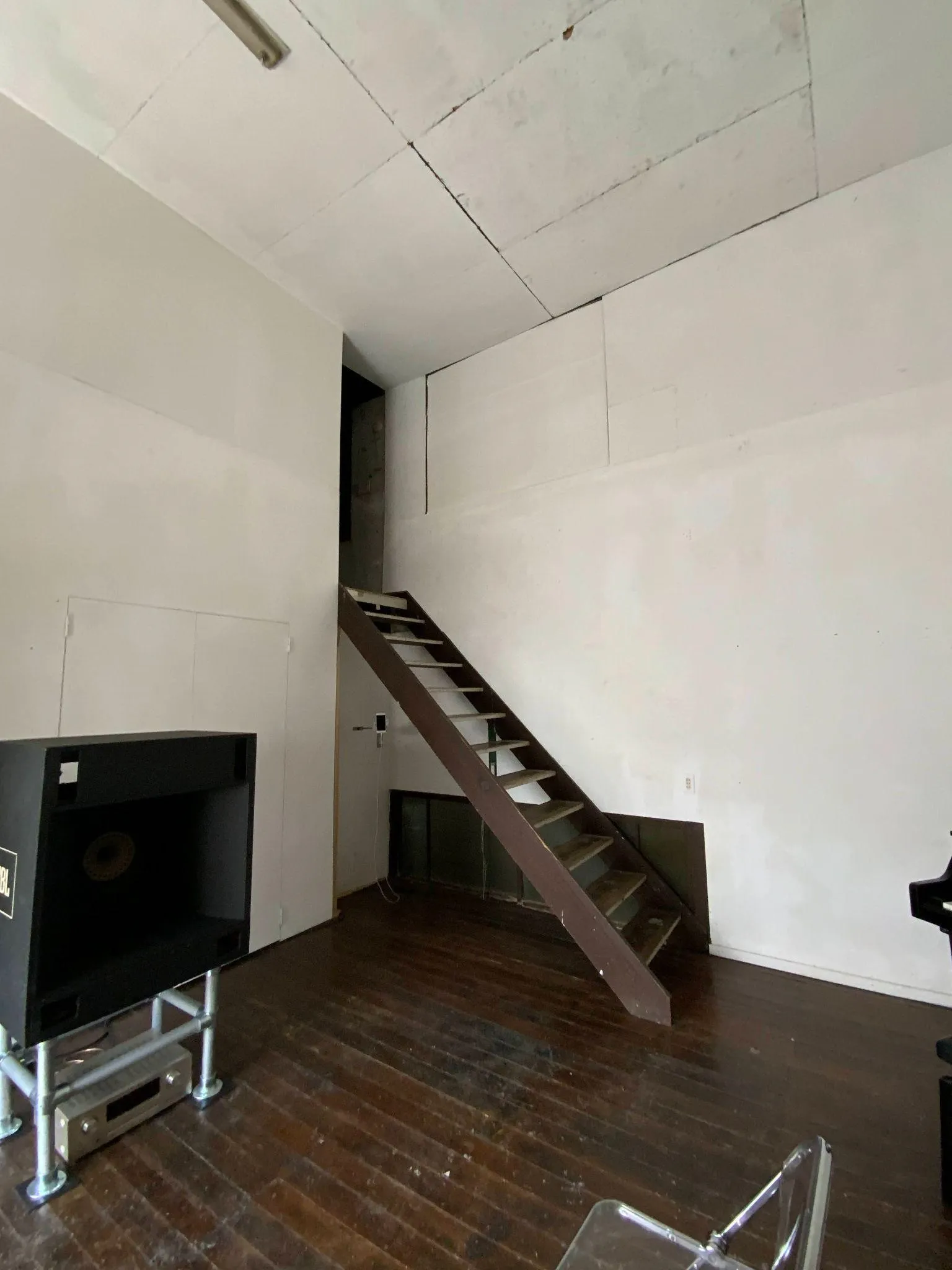
- Image of gallery space.
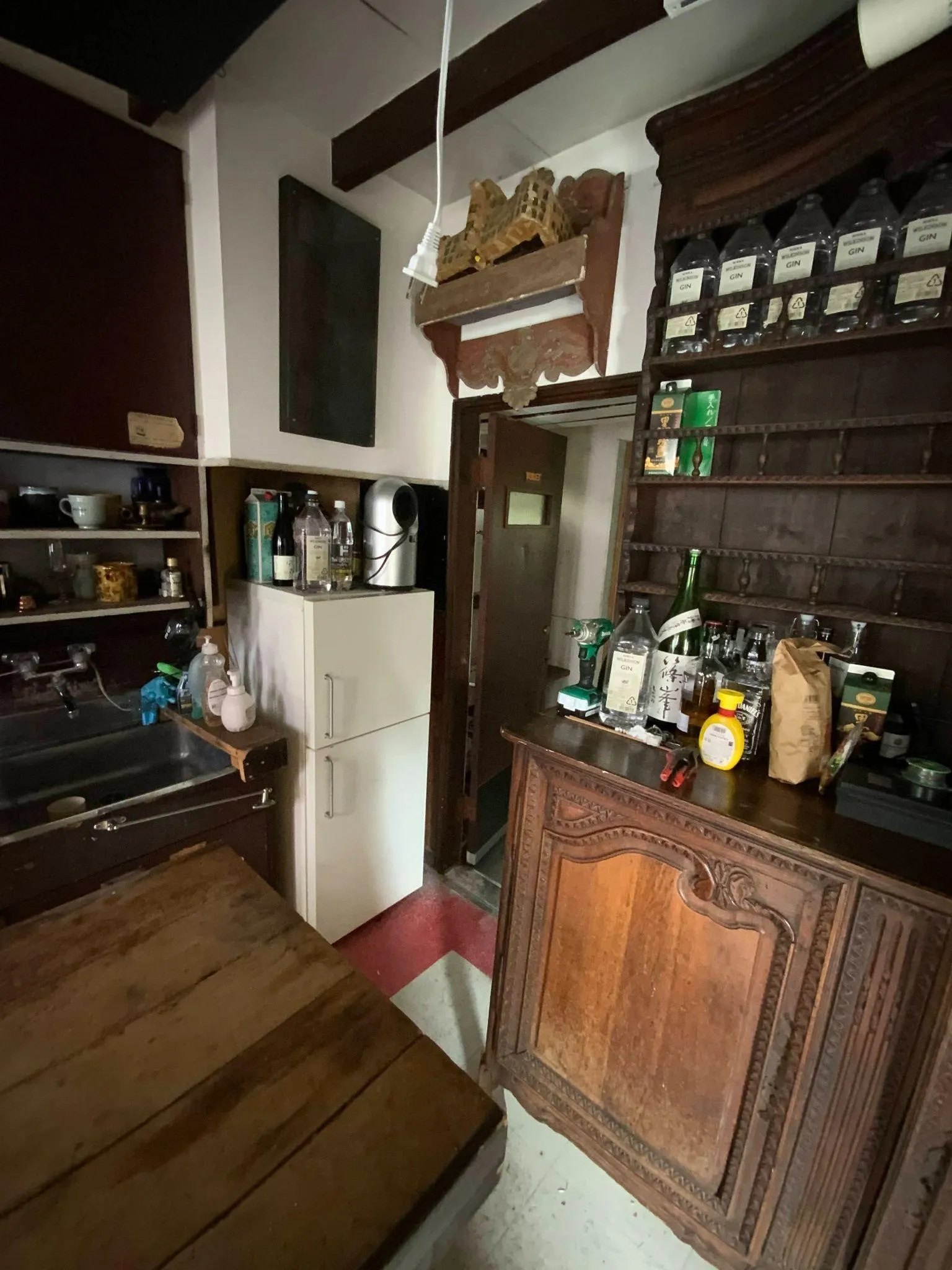
- Image of Kitchen space.
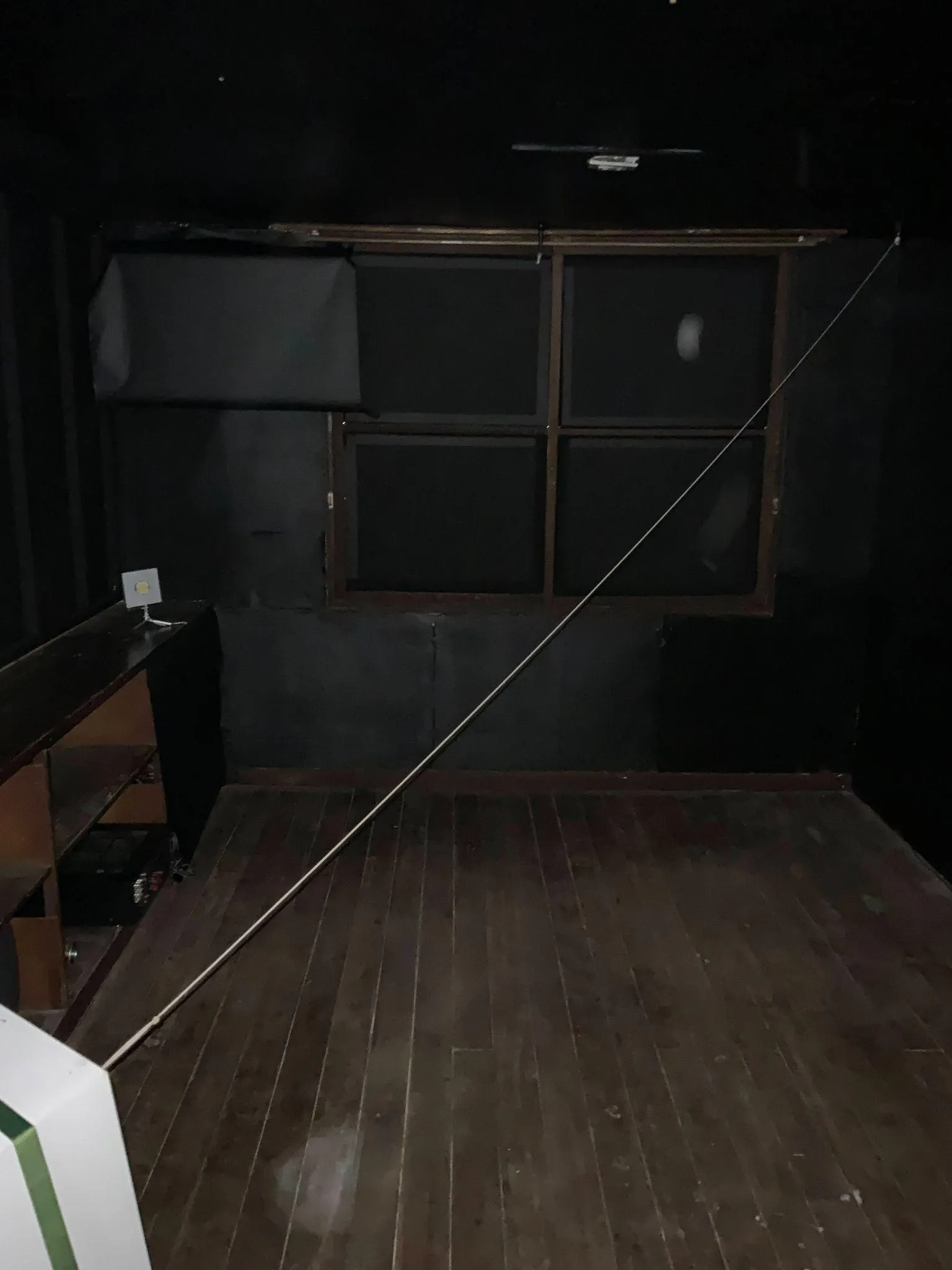
- A small room on the second floor.
Photos: Kengo Sato
3. Relationship with surrounding urban conditions
Neo-Dada Organizers’ activities were rather radical in the outer space of the city at the beginning. Due to the extremeness of the activities, it was sometimes difficult to carry them out in urban spaces. I think that’s why they realized their expression in Shinjuku White House.
So, Shinjuku White House was kind of their Asyl. I think that’s where holding parties and artistic expression came together.
In terms of the appearance of the building, at the time of its construction, there were probably no houses with white walls in Japan, and all of them had walls made of wooden boards. So I think this pure white outer wall stood out from the surrounding buildings.
I also read about your exhibition proposal. Thank you.
Building a support wall is interesting. It’s a device that functions as the infrastructure of the White House, not just for this exhibition period. I am interested in what kind of grounds will be used to determine the shape of this temporary product.
My current idea is that there may be an approach to the acoustic space. I haven’t come up with too many details, but it’s about making some kind of sound and speakers.
I would also like to talk with you about the possibilities of the word PLAYFUL in the title of this exhibition. Somehow, the word PLAYFUL has a very modern nuance. It is not shared with Isozaki and Neo-Dada Organizers, who have aggressive and disruptive attitudes toward their society. I feel that we have become a little more of a fictional existence.
Sincerely,
Kengo Sato
230605/23:30(JST)/Kengo Sato
I think the word playful is a very dangerous word. Each of us may have different meanings for the word when looking at our way of life. I think that your way of thinking is influenced by the way you live, the environment you live in, the country you live in, the projects you are interested in, and so on. Or maybe you can act like you’re joking.
I’m going to go ahead and think about the idea of making a loudspeaker. For example, the speaker can be placed in the support space such as the kitchen or inside the warehouse of Shinjuku White House to generate sounds, and then through the wall to vibrate the white cube. Or it might be very interesting to try using the attic space. So, I wrote down the idea of several rats rummaging around in the attic. I think rats are kinds of icons of downtown Shinjuku.
Gaston Bachelard once wrote about the fascination with attic spaces. I find it interesting to focus on such hidden places. We can be more imaginative about the quality of space with certain hidden parts.
Kobo Abe(1924-1993) was a Japanese novelist of the same generation as Arata Isozaki. I feel that the quality of the seemingly strange space that Abe drew in his novels is close to the space and situation we are trying to achieve here.
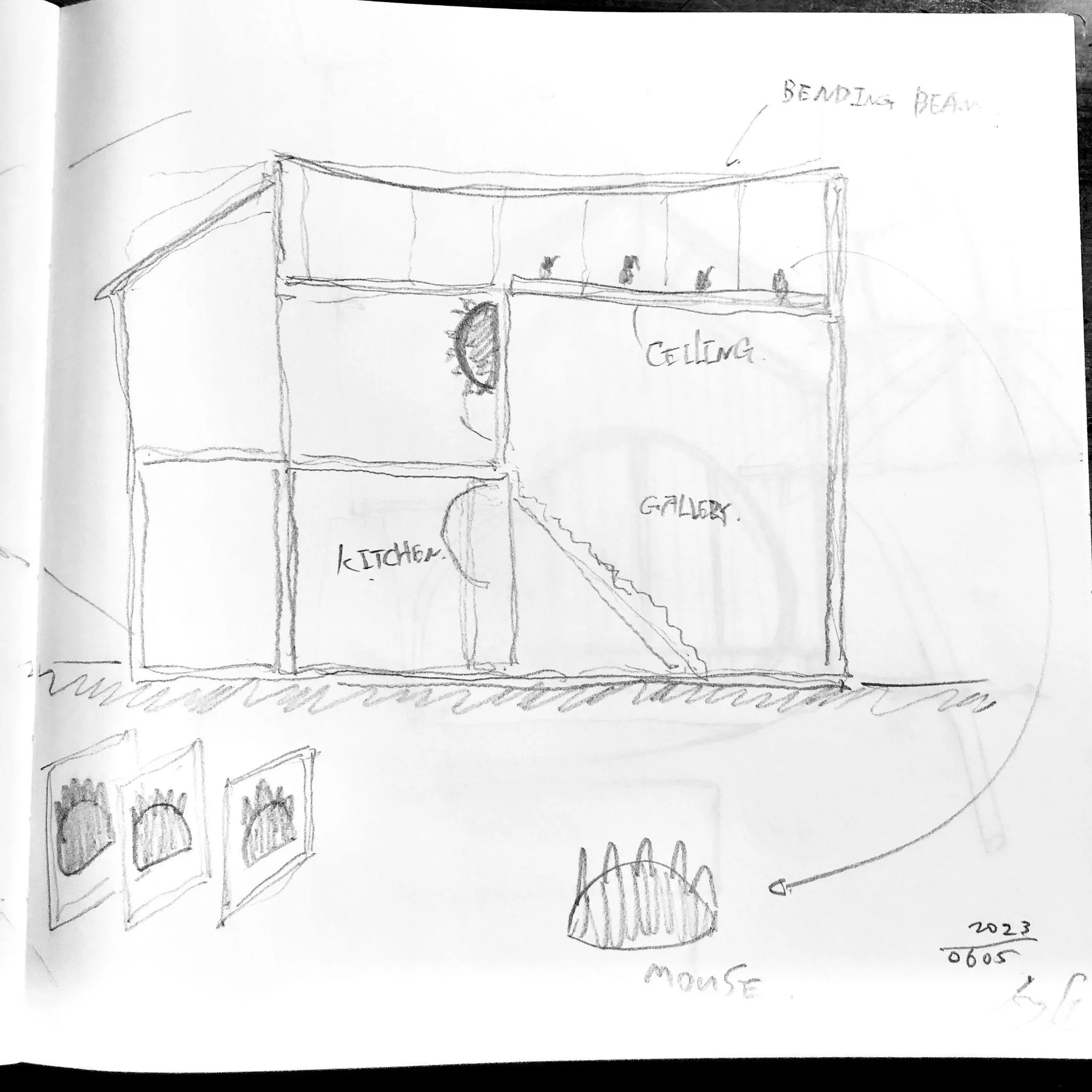
- Sketch 230605 by Kengo Sato
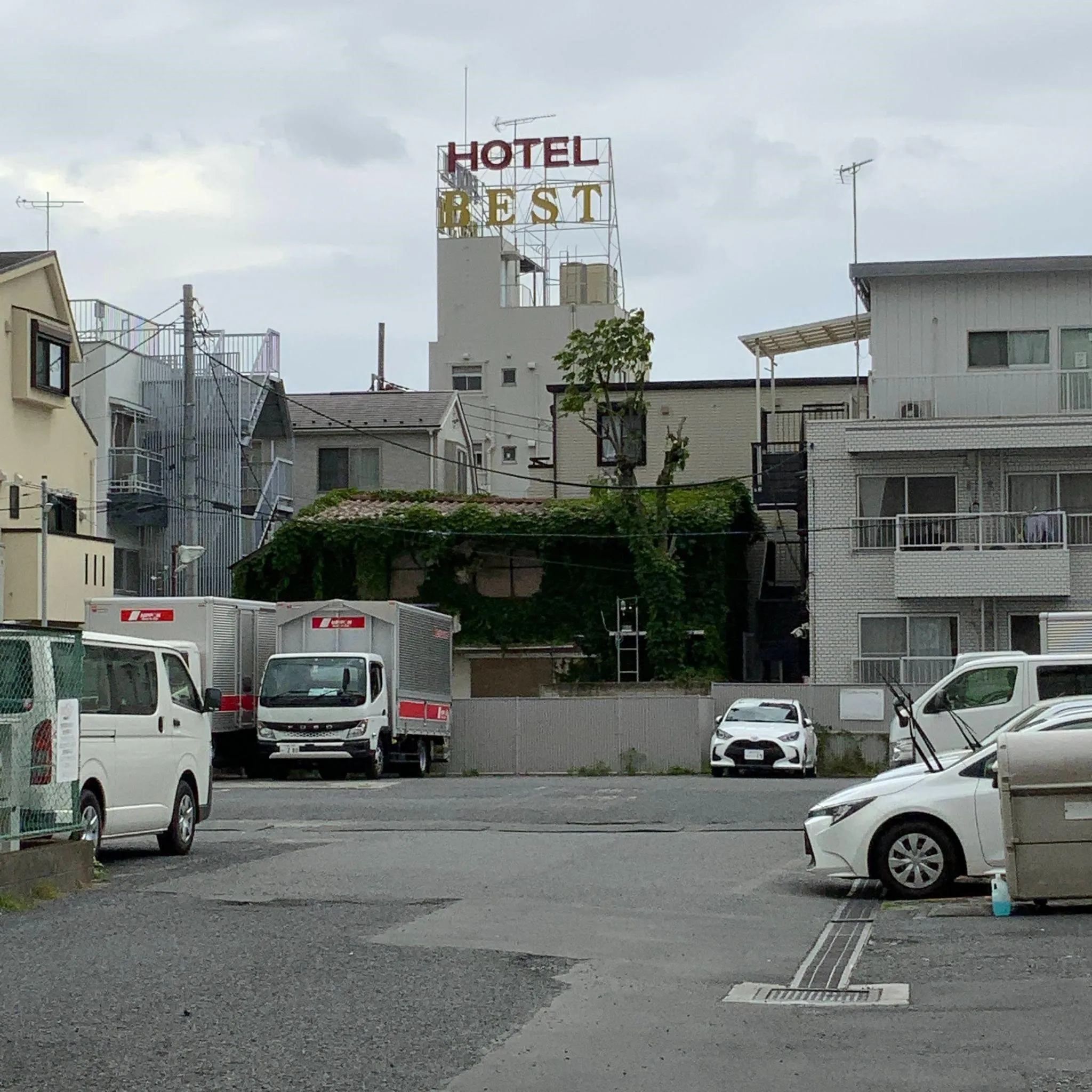
- Outside pers of Shinjuku White House.
Photo: Kengo Sato
Kengo Sato
230606/12:00(CST)/Nathan & Francisco, Departamento del Distrito
Hi Kengo,
I’m so glad that we found the time to speak via Zoom yesterday. We enjoyed the conversation.
Here are a few points that were discussed:
Installation Proposal
(1) At its core, the installation explores the hidden technologies, devices, and support structures that are embedded in Shinjuku White House and the surrounding Shinjuku neighborhood. These elements serve as essential infrastructure for the main gallery space and are housed in a collection of counter-spaces that often go unrecognized (e.g. the closet, the attic, the sewer).
(2) The installation takes these elements as raw material for the proposal — asking how their relationship with the exhibition-goer (public) can be reconceptualized to produce new forms of interaction, friction, and experience there.
(3) In its simplest version, the installation is composed of two elements: (1) a speaker emitting recordings from the Shinjuku neighborhood and (2) an anonymous service wall. The exact relationship between the speaker and the service wall is to be determined.
(a) NOTE: We see a possibility for the speaker to be either (a) embedded within the service wall or (b) attached to the service wall in some way. What do you think?
(4) Projection may also be incorporated.
(5) Developing our stance towards the role of “play” and “playfulness,” the installation may evoke the supernatural phenomenon of Yōkai, entities of Japanese folklore that “can range from malevolent or mischievous, to benevolent to humans.”
Project Reference, Departamento del Distrito (Mercado Libre)
Installed as a floating intervention at the Museo Numismático Nacional in 2019, Mercado Libre is a continuous horizontal surface that acts as both roof and infrastructure. Any direct connection between this installation and Isozaki’s Festival Plaza is coincidental (or at least subconscious). But, we see some common themes between our current proposal for WHITEHOUSE and this previous work – the design of an anonymous infrastructural system that can support a variety of objects, technologies, and programs.
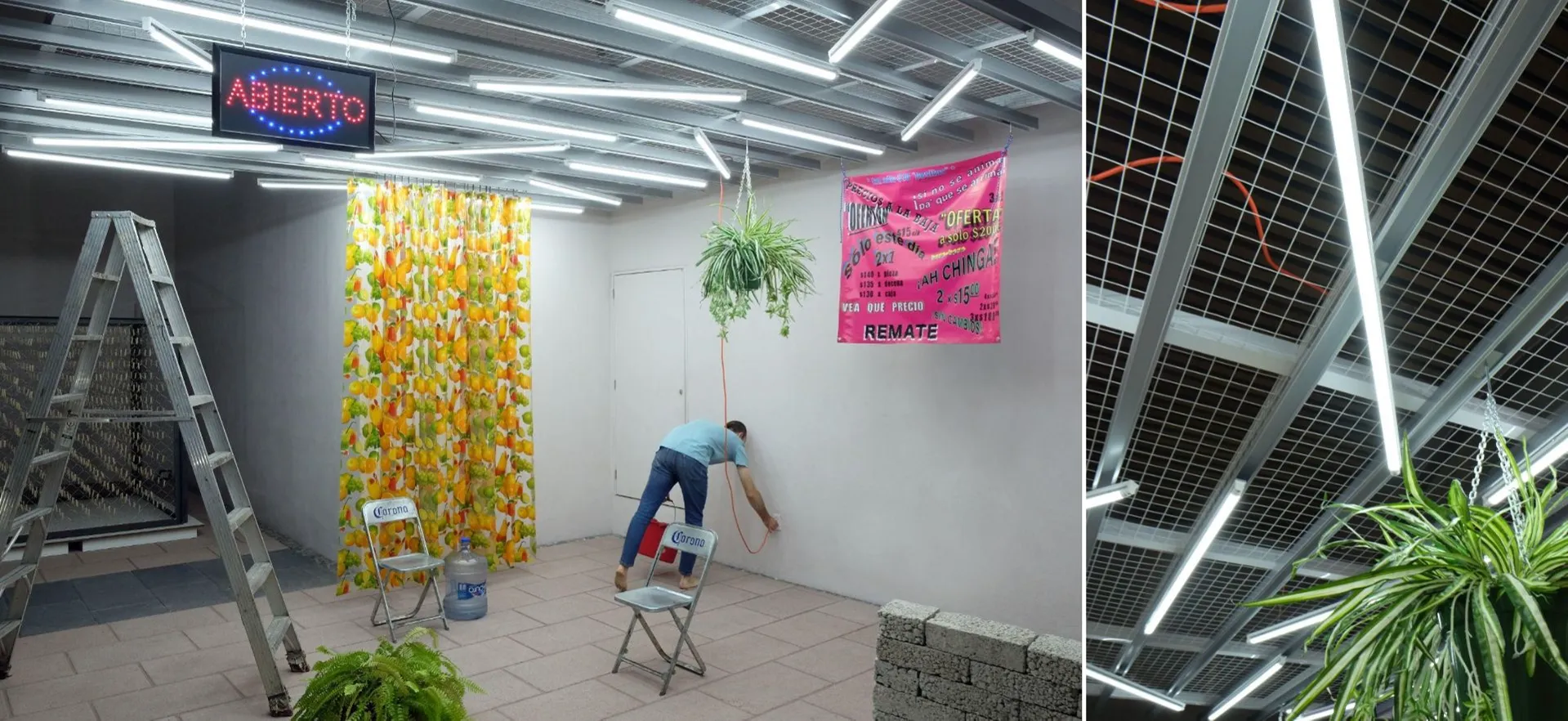
- Mercado Libre at the Museo Numismático Nacional, Mexico City, 2019.
Project and images by Departamento del Distrito.
Mercado Libre was produced for the 2019 edition of the Abierto Mexicano de Diseño and installed at the Museo Numismático Nacional, a 16th-century Spanish colonial building in Mexico City’s historic center. The ceilings are extremely tall in this space (approx.12 m), and the installation was hung from above.
The project was accompanied by an investigation on spaces of mass commerce throughout Mexico City. We analyzed how the ceiling plane operates as an infrastructural system across various different typologies. The element is commonly structured to allow for large, uninterrupted spans of open space, supports lighting and electrical systems, and serves as a display device from which signage, decorations, and sale items are hung. Mercado Libre extracts, translates, and redesigns the ceiling plane in the form of a temporary installation. We worked with a local company called Grupo RIHO, who specialize in drop ceilings, for fabrication.
Please let us know if we are missing anything, or if any of the above points require clarification and/or revision.
Finally, thank you for answering the questions listed in our May 15th post. We appreciate your careful attention to detail and the photographic documentation from your site visit. All valuable resources.
Best,
Nathan and Francisco
230609/10:30(JST)/Kengo Sato
Thank you very much for summarizing the content of the discussion on ZOOM.
Based on the information I received, here are my ideas.
We can also sometimes fabricate hidden technologies, devices, and support structures as exploring them. Then,
(1) I believe it is important that the speaker emitting the recordings will be hidden behind a wall or ceiling of the gallery. The hidden speaker lets visitors imagine another world or room exists.
(2) The fragmentary figure of the hidden existence is displayed on the surface of the anonymous service wall. It may be better to use a projector to show the image. Visitors can imagine the hidden world by looking at the image displayed on the service wall.
(3) Therefore, it is better to separate the service wall and the speakers from each other. The service wall exists as a device, a “window,” to peek into another hidden world.
As for the image of the hidden existence, I am currently thinking of rats in the context of the city of Shinjuku or as ambivalent creatures that combine dirtiness and cuteness. However, it may be necessary to redesign and update the appearance from now on.
Anyway, we need to think about the production process and how you and I could collaborate.
The following is an example. I thought about dividing it into several work phases and alternately sending the results to each other.
Here are some examples:
1. Korogaro = Collect the sounds (soundscape) of the city of Shinjuku, and send the audio data.
2. Departamento = Edit the audio data and create a sound (or a sort of noise?) that shows the hidden existence.
3. Korogaro = Design and make a speaker that outputs the sound. The shape of the speaker is the base of the fragmentary image projected onto the service wall.
4. Departamento = Design a service wall that projects fragmentary images of the speaker. The service wall shall be prefabricated. Send the design data.
5. Korogaro = Make the service wall based on the design, maybe, using a CNC router.
6. Korogaro = Install the service wall, the speaker, and various electrical devices at the venue.
By going through this process of work, we can try to realize an expression with multiple grounds by intermingling each individual idea.
Regards,
Kengo Sato
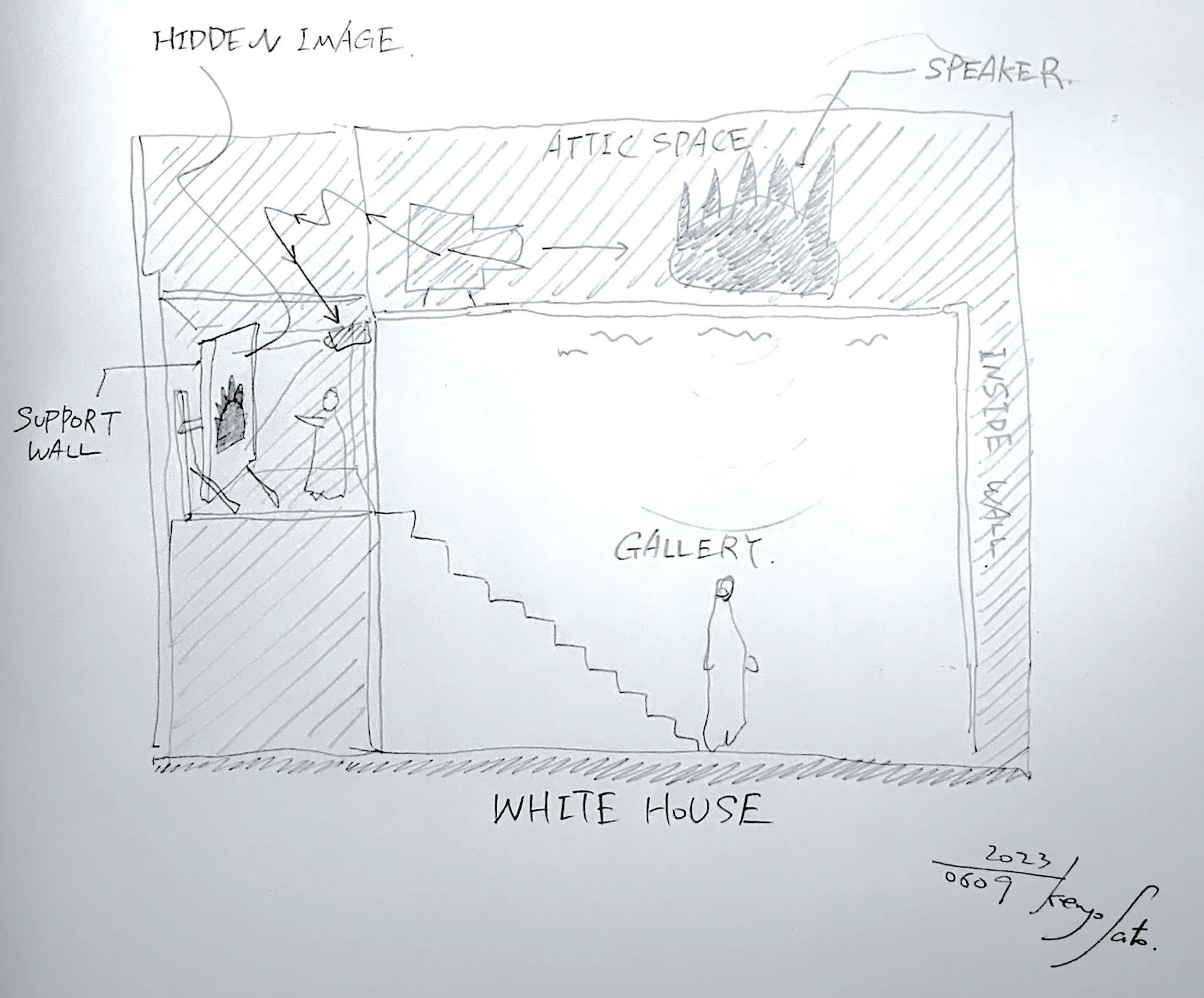
- Sketch 230609 by Kengo Sato
230614/17:15(CST)/Nathan & Francisco, Departamento del Distrito
Hi Kengo, thanks for your message.
We like the workflow proposal very much. It provides a useful structure for collaboration and will generate an unexpected outcome. It underlines that there is no pure position to uphold. Our exchanges of information will be mediated through acts of translation—across countries, cultures, and design practices—to arrive at the final installation.
Admittedly, we have not done a lot of sound mixing but are open to taking on that aspect of the proposal.
Based on your most recent sketch, we have the following thoughts:
(1) We understand your reasoning for placing the speaker behind a wall or ceiling of the WHITEHOUSE gallery. Let’s proceed with that idea.
(2) The service wall can easily be developed to incorporate a projection or screen. We like the idea that the projection or screen will act as a window into another world.
(3) In your sketch, the service wall and projection are located on the second floor. This is the only aspect of the proposal that we would like to reconsider and request that the service wall be located on the ground floor. The idea that the project is mobile and can exist in many places over time is important to us.
Inevitably, our installation will have to be coordinated with the other participants, so we look forward to learning more about their proposals. Hopefully, this information will be shared soon.
All best,
Nathan and Francisco
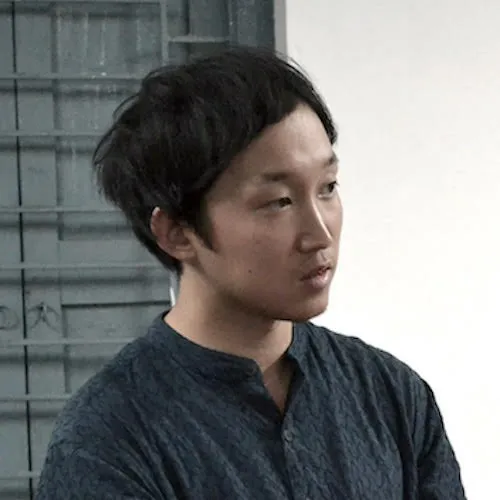
- 佐藤研吾/Kengo Sato
- 1989年生まれ。建築家、一般社団法人コロガロウ/佐藤研吾建築設計事務所主宰。現在は福島県大玉村を拠点に据えつつ、福島-東京-インドという複数の地点を往還するなかでの創作活動に取り組む。同村では東日本大震災の後から活動を開始した藍畑を世話し藍染めを実践する創作グループ・歓藍社に所属。主なプロジェクトに、《北千住BUoY》(2017)、《シャンティニケタンの住宅》(2018)、《Iさんの避難観測所》(2023)。 Kengo Sato, born in 1989, is the founder of Korogaro Associaton/ Kengo Sato Architecture design office. The office operates in an inclusive and global approach, with bases in Fukushima, Tokyo, and India. Based in Otama, Fukushima, he is rooted in the land of inspiration from the landscape and cooperation with local farmers. His work covers a wide range of areas, from artworks to public buildings. He held the sculpture exhibition Cavities and Enclosures in 2022. His architecture projects include Kitasenju BUoY in Tokyo(2017), House in Santiniketan in India (2018), Evacuation Observatory of I in Saitama(2023), and so on. With curiosity and certainty, he joined the indigo dye group Kanransha in Otama, developing indigo as a focus, caring for the alternative community after the Nuclear explosion.
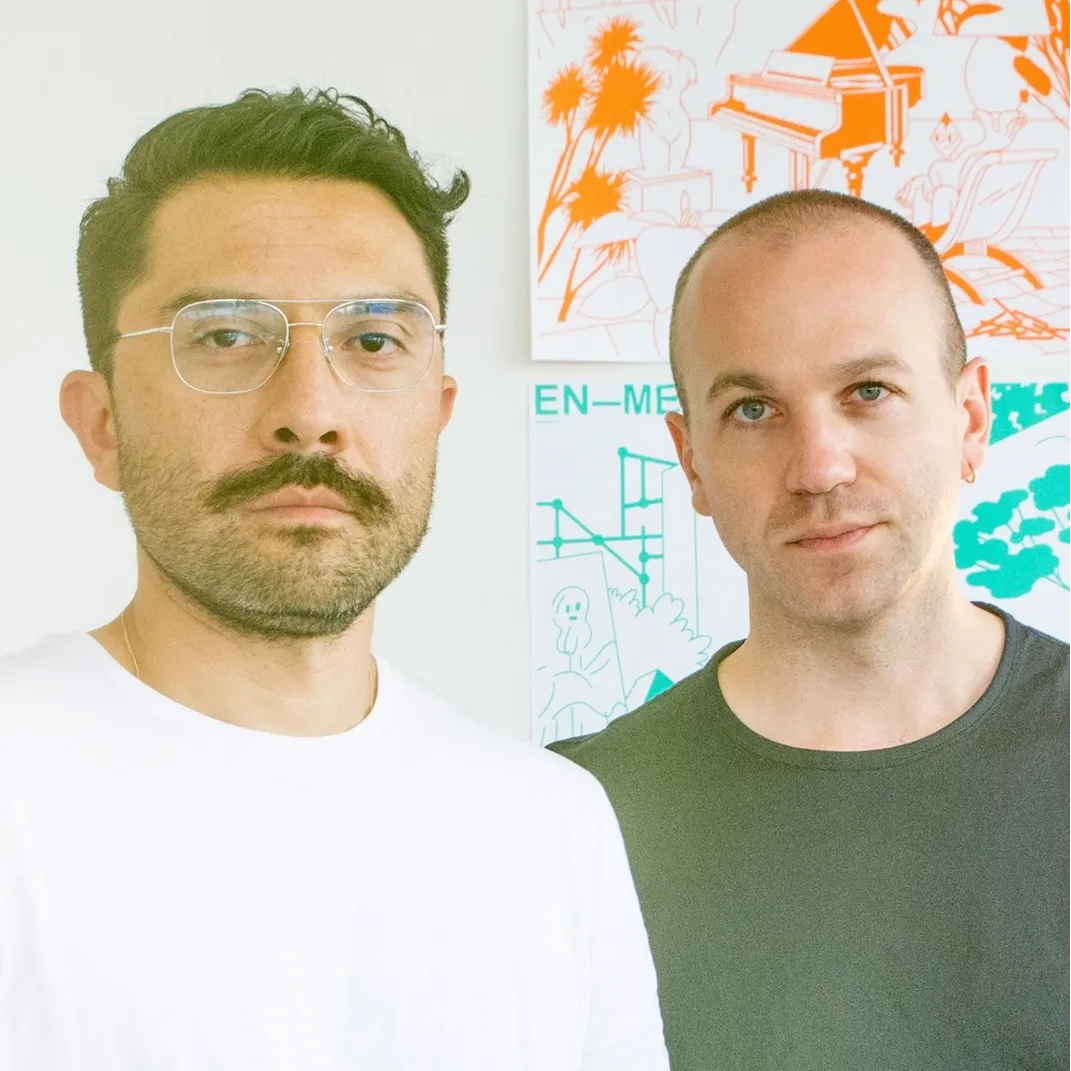
- デパルタメント・デル・ディストリト/Departamento del Distrito
- デパルタメント・デル・ディストリトは、フランシスコ・キニョネスとネイサン・フリードマンが2017年に設立した、メキシコシティを拠点とするデザイン事務所である。政治、アイデンティティと、建築環境の交差するところで活動する多様な作品群が評価され、2022年のニューヨーク建築連盟賞を受賞した。プロジェクトは国際的にも注目されており、国立建築博物館(ワシントンD.C.)、Het Nieuwe Instituut(ロッテルダム)、アルカンレーヴ建築センター(ボルドー)、国立貨幣博物館(メキシコシティ)、グラハム財団(シカゴ)などで、これまで展示されている。 Departamento del Distrito is a Mexico City-based design office founded in 2017 by Francisco Quiñones and Nathan Friedman. The practice was recently awarded the 2022 Architectural League of New York Prize, recognized for a diverse body of work that operates at the intersection of politics, identity, and the built environment. Projects by Departamento del Distrito have been exhibited internationally, including shows at the National Building Museum (Washington, D.C.), Het Nieuwe Instituut (Rotterdam), arc en rêve centre d'architecture (Bordeaux), Museo Numismático Nacional (Mexico City), and the Graham Foundation (Chicago).
#2 GROUP ⇄ ANY < 前の記事