

F2-2-2
Part2 往復書簡/Correspondence
#2 GROUP ⇄ ANY
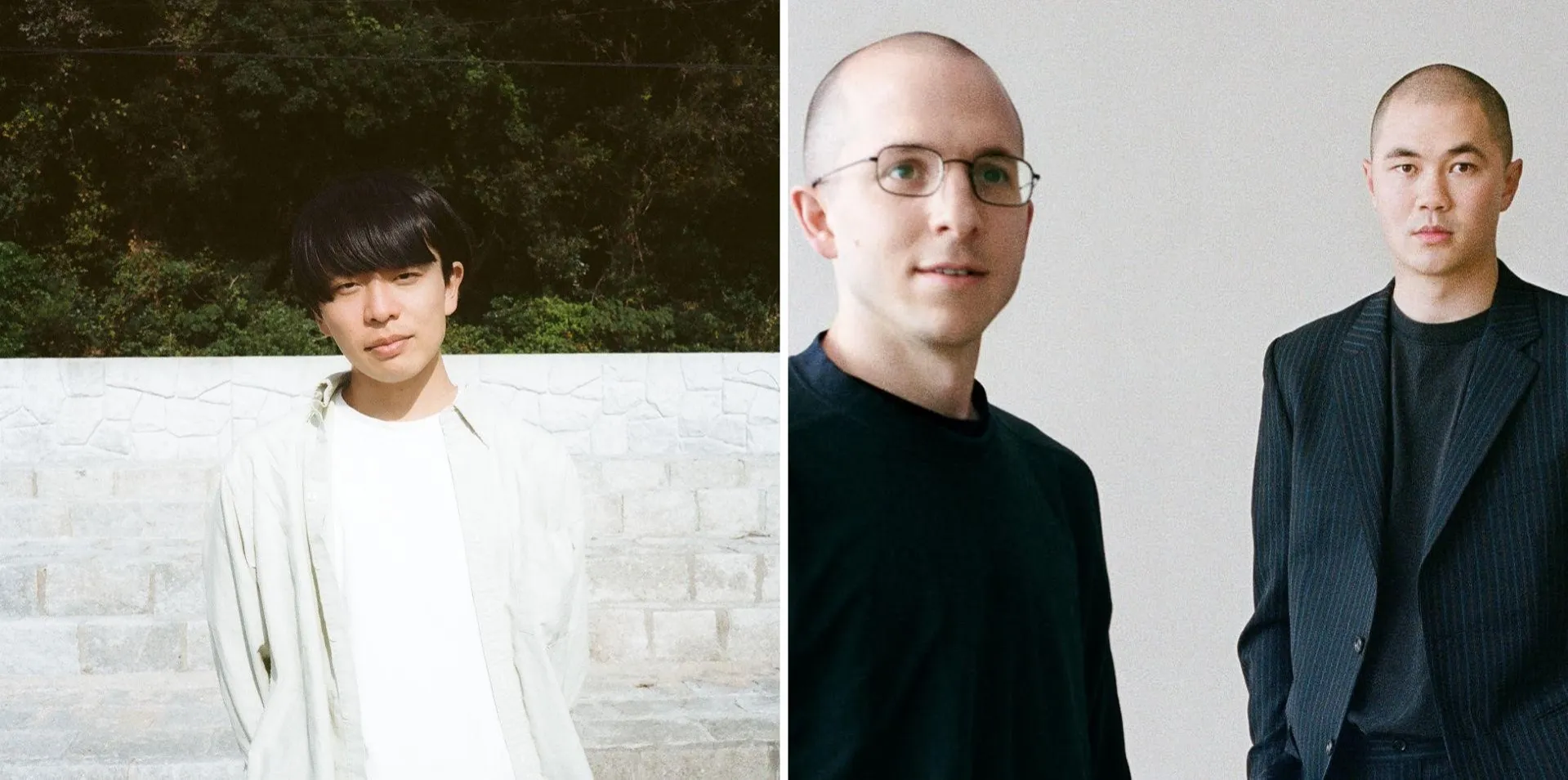
4 pairs of Japanese and North American architects exchanged texts and images before opening the exhibition at Shinjuku White House (currently, members-only art space “WHITEHOUSE”) and “a83” in New York fall 2023. Each pair shares conversations on a document-sharing file online between them and processes to make the installation together. #2 is a correspondence between the Tokyo-based architectural collective GROUP and the New York-based design office ANY. (For more information, please see #0.)
-
Contents
-
230424/12:44(JST)/Gaku, GROUP
Thanks for the first meeting of this exhibition.
Let me talk about Arata Isozaki for a moment.
I am curious to know how Arata Isozaki has been received in the United States.
In Japan, Arata Isozaki is recognized not only for his architectural works, such as the Tsukuba Center Building (1979-1983), and his writings on architectural deconstruction, but also as a curator, as when he selected Kazuyo Sejima, Akiko Takahashi, Christine Hawley, and Elizabeth Diller for the Hi-Town Kitagata Housing (1994-1998) in Gifu, Japan.
Which of Isozaki’s architectures and writings are mostly mentioned in the U.S.?
ANY, do you have any references to Arata Isozaki?
I look forward to your reply.
I will send you a report on Shinjuku White House (1957) in a little while.
240424/22:37(EST)/Nile & Michael, ANY
Nile Greenberg:
Thank you for the invitation, Gaku. We’ve been very interested in your work, so it’s very exciting to propose something together.
Isozaki is someone I am definitely aware of, though the depth of his work is not extremely widespread.
I have visited The Museum of Contemporary Art, Los Angeles (1981-1986). It’s mainly known here for its vivid drawings of the project. The museum has a successful attitude to the city around it, creating a dense site of exterior action in a lost neighborhood. It’s a collection of small architecture raised on a plinth. Each building seems to have a function for the museum, but as you descend down the plaza and into the museum, it’s very unclear if you will meet those again.
His work at Gifu was groundbreaking. Both Liz Diller and Kazuyo Sejima’s projects are extremely important for us and we continue to study them.
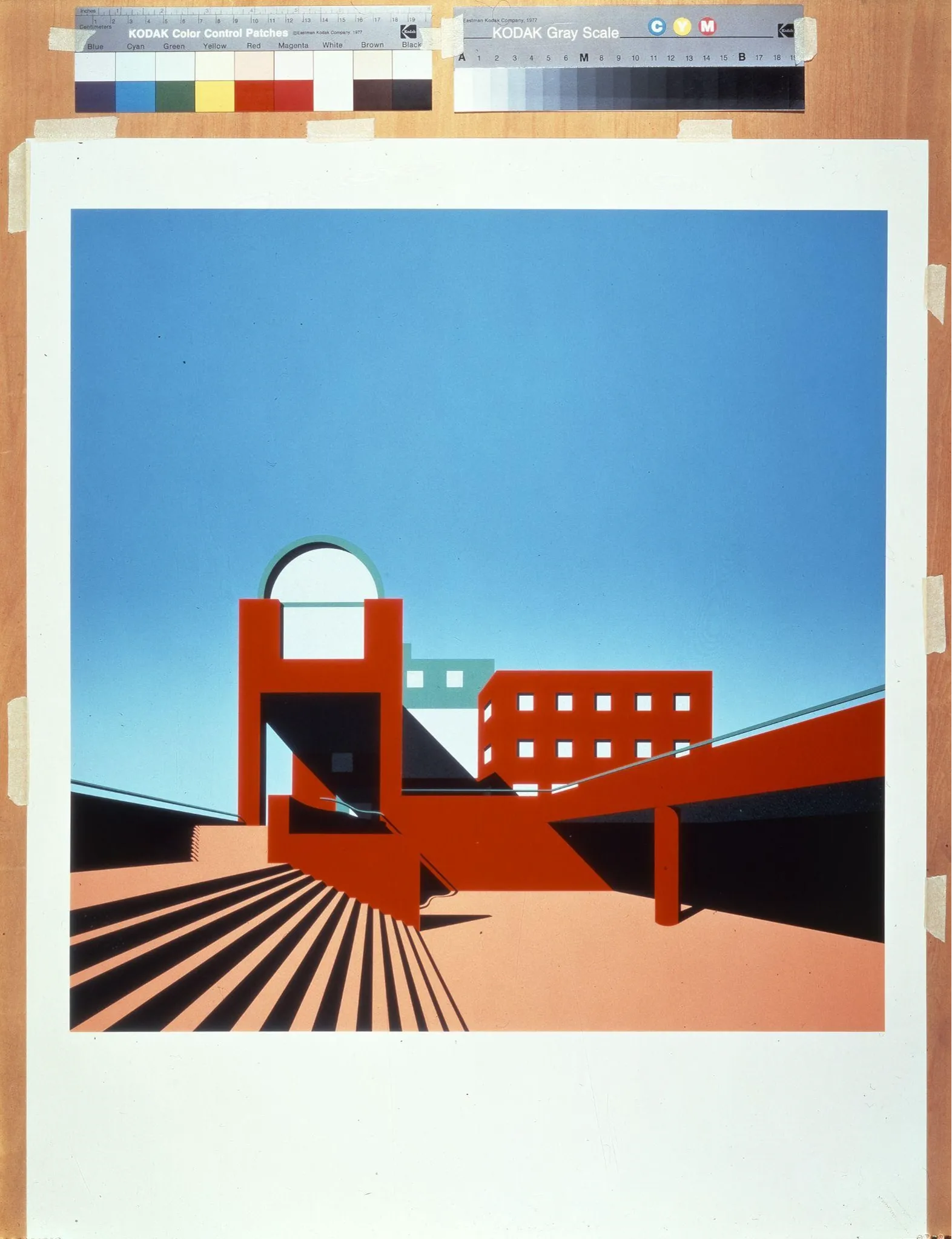
- MOCA #3, Arata Isozaki, Screenprint, 1983.
©︎Estate of Arata Isozaki
Michael Abel:
Palladium Club (1983-1985) in New York City by Isozaki has been a point of reference in our own work and research thinking about scenography and performance. There are very few instances of clubs as canonical architecture. It feels like Isozaki has no style in a way…and you might say that it is a continuous representation of culture, constantly evolving. In this case, The Palladium is surfaced with literal paintings from his contemporaries.
Nile Greenberg:
I’ve had a copy of his book Japan-ness in Architecture (MIT Press, 2006) for years but have not read it until we began this research… His thesis in this book focuses on the collision of how Japanese and Western Architects look at Japan. It is very fascinating how he then reverses the dynamic by references Western architecture with a Japanese lens.
Gaku, a question for you about your practice. One of the reasons I’ve appreciated GROUP is that your practice’s work is often focused on renovations and maintenance. From what I understand about contemporary architecture in Japan, the culture (and financial model) of real estate is completely different in that the value of a house quickly loses value once it’s built and demolition is quite common. Is this generally true? If that’s the case at what point does a building get old enough that its value mandates that it stays intact and in good repair? How has Shinjuku White House fought this dynamic?
230505/07:05(JST)/Gaku, GROUP
Thank you for your reply and comments regarding Arata Isozaki. To research Arata Isozaki, one needs to learn not only about architecture, but also about text, curation, and the nature of the communities he created, such as the Anyone Corporation (ANY) series which documents the ANY conferences in Japan. If you would like to do some research, why don’t you read one of the series?
For the upcoming exhibition, I would like to decide which parts of Shinjuku White House that our team will touch with this time: ceilings, walls, floors, and furniture. I will share some pictures of the interior of Shinjuku White House. Which part are you interested in renovating?
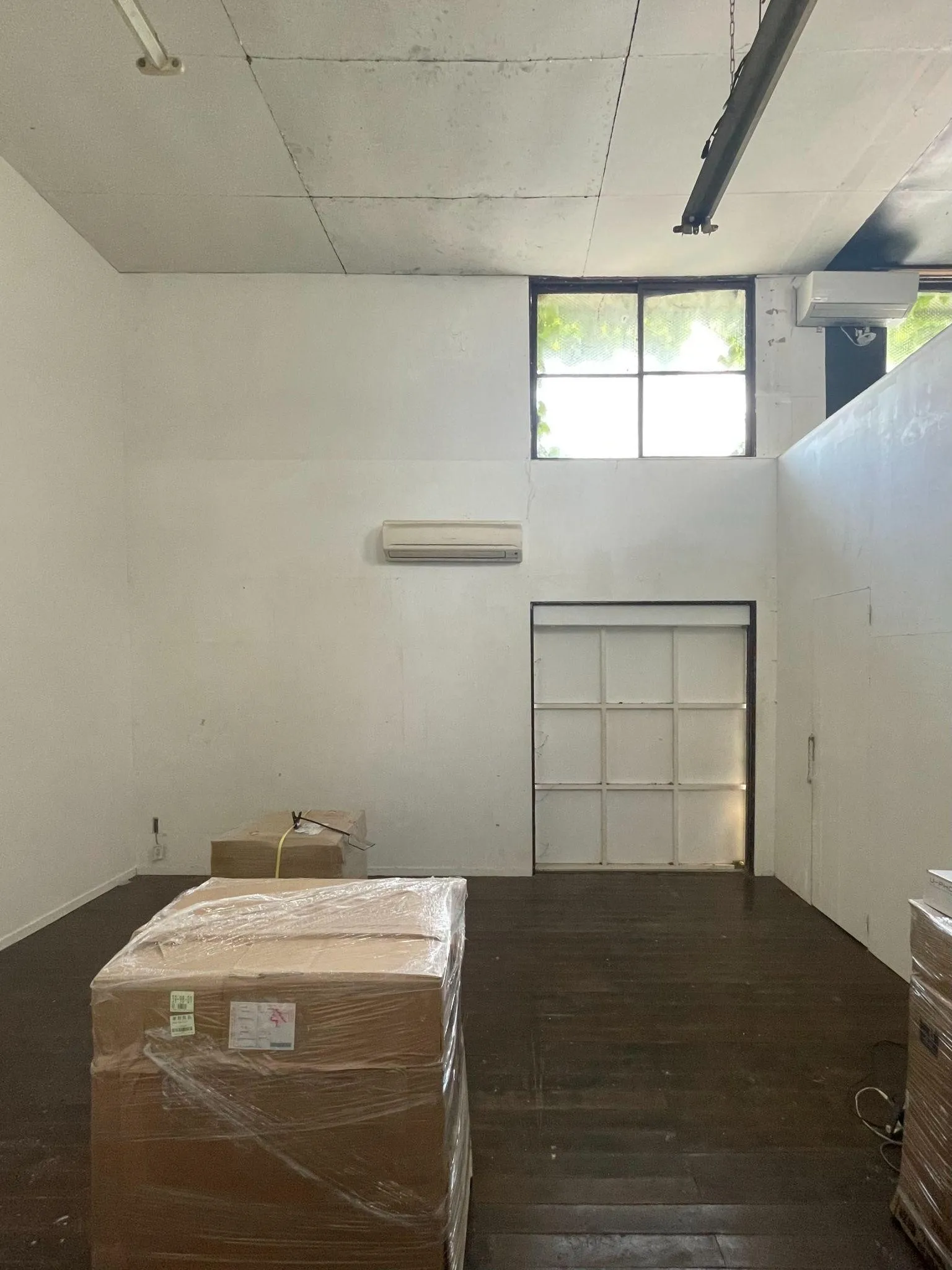
- View of the entrance from the ground floor
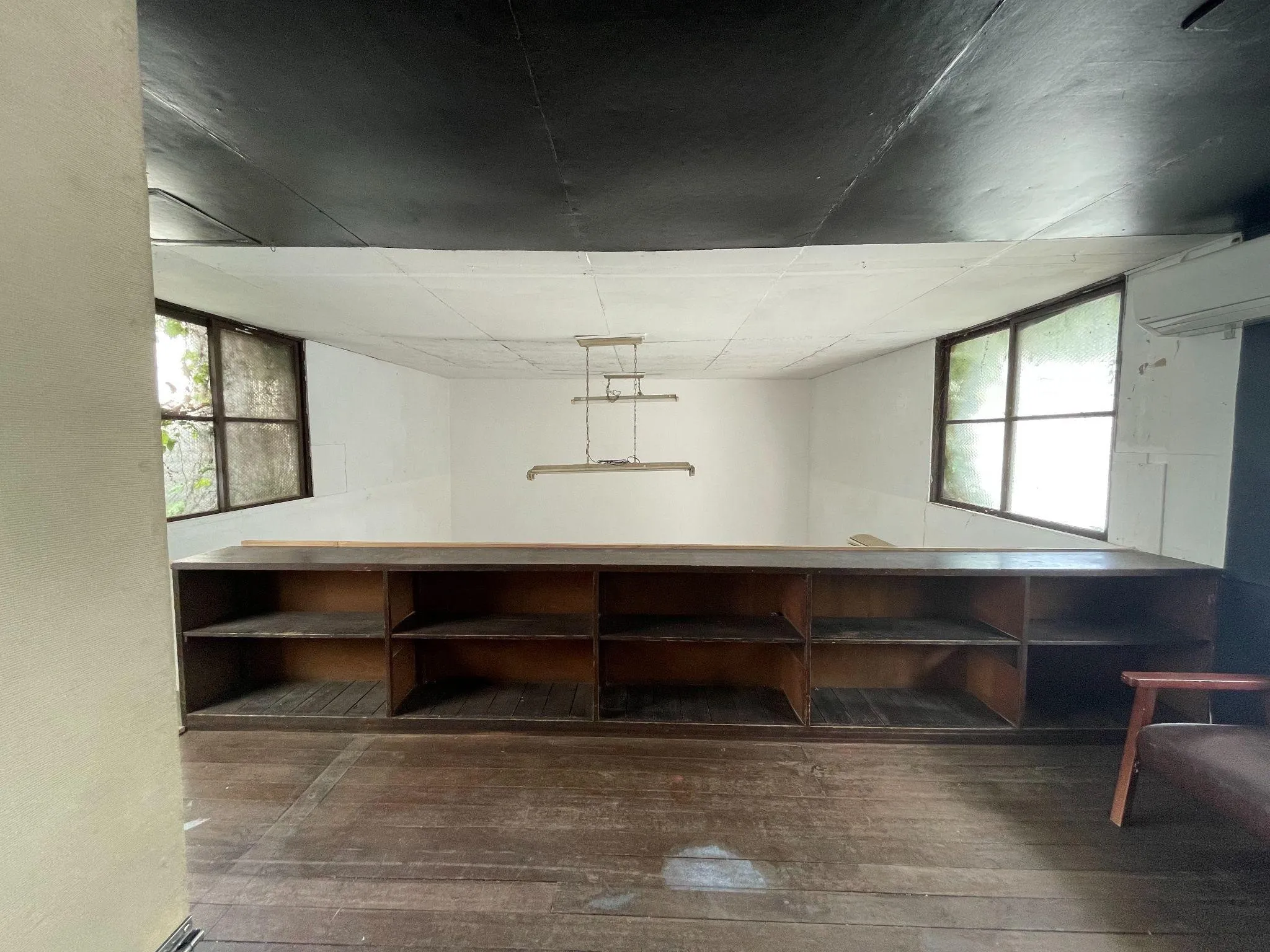
- View of the atrium from the second floor
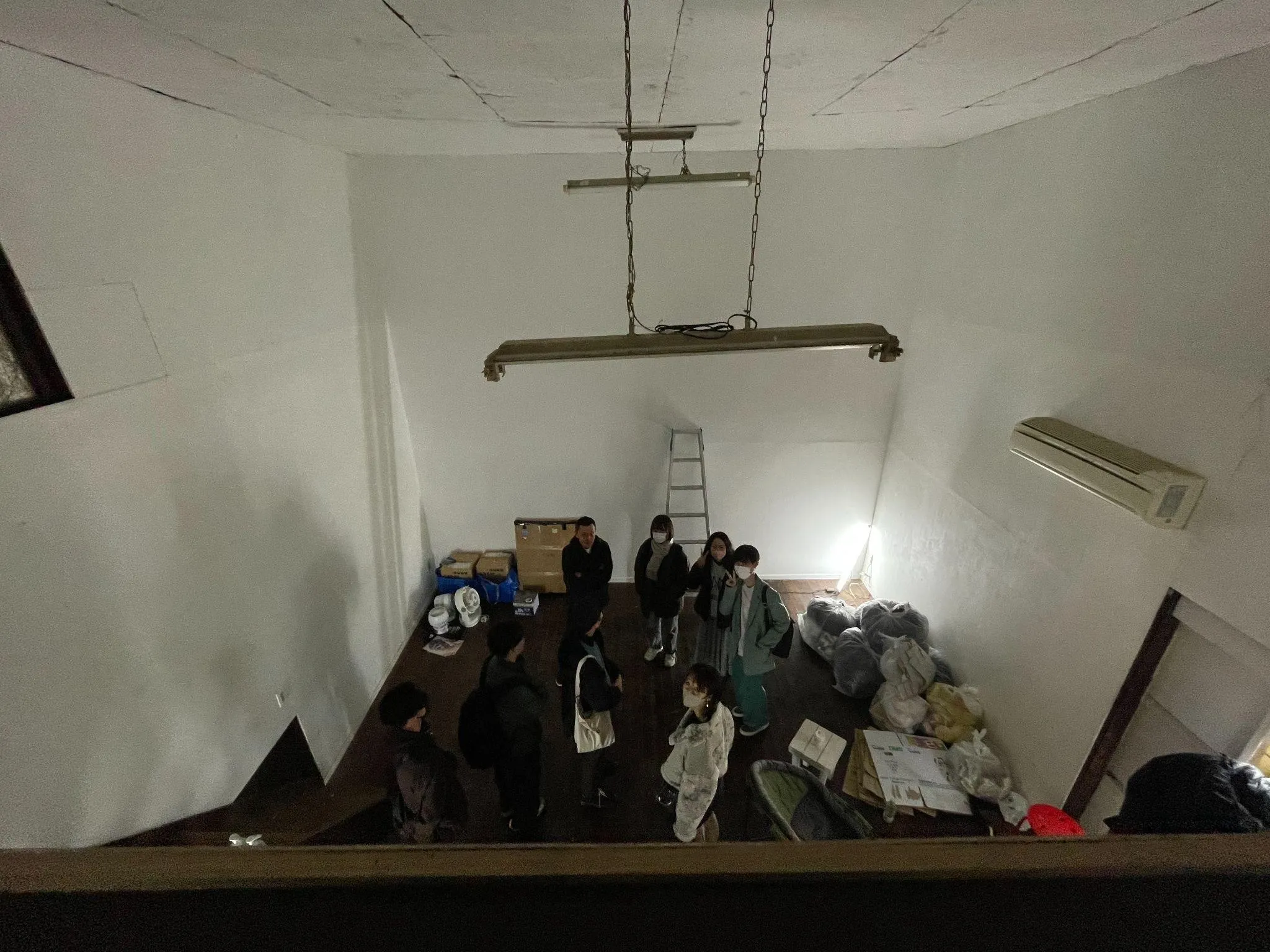
- Looking down on the ground floor from the second floor
Photos: Gaku Inoue
As for the answer to your question, the value of most detached houses in Japan begins to decline the moment they are built. Therefore, new owners often build a new house rather than keep and renovate the old one. Some Japanese architects referred to this situation as functioning as a metabolism when considering the city block as architecture. In the case of rental houses, the occupants are required to return the house to its original condition, and when they move out, they have to return the house to a brand new condition.
However, given Japan's declining economic situation, we feel that in recent years, people are increasingly willing to continue to use their homes by renovating and maintaining them rather than tearing them down and building new ones.
What role can architects play in this situation, and what kind of aesthetics can we create? I think this is one of the indispensable challenges for our generation.
240514/12:11(EST)/Nile & Michael, ANY
Nile Greenberg:
Gaku, In light of these concerns around the preservation and the maintenance of the house itself, we are interested in designing a single structural column that supports the roof beam that is failing. It may not be a permanent solution, but by reinforcing the beam the concept of repair can be clearly architecturalized.
A column in the space contradicts the open plan that Izozaki has produced at Shinjuku White House. By repairing the roof, a new organization emerges within the space.
Michael Abel:
Regarding the column…one thing that we’ve been interested in is this tension between a repair column versus a monumental column. Isozaki’s structure for the facade of Zendai Himalayas Center or the structure on Qatar National Convention Centre breaks symmetry and in a way that becomes less monumental through a type of biomimicry. For the column ANY designs, we would like to combine a typical temporary repair column and a monumental column to see how this changes the spirit of the space.
230524/02:43(JST)/Gaku, GROUP
Nile, Michael,
I think the new columns for Shinjuku White House are a good idea.
Which location would be best, looking at the drawings I see several possibilities for where the columns could be placed. Where would you envision them?
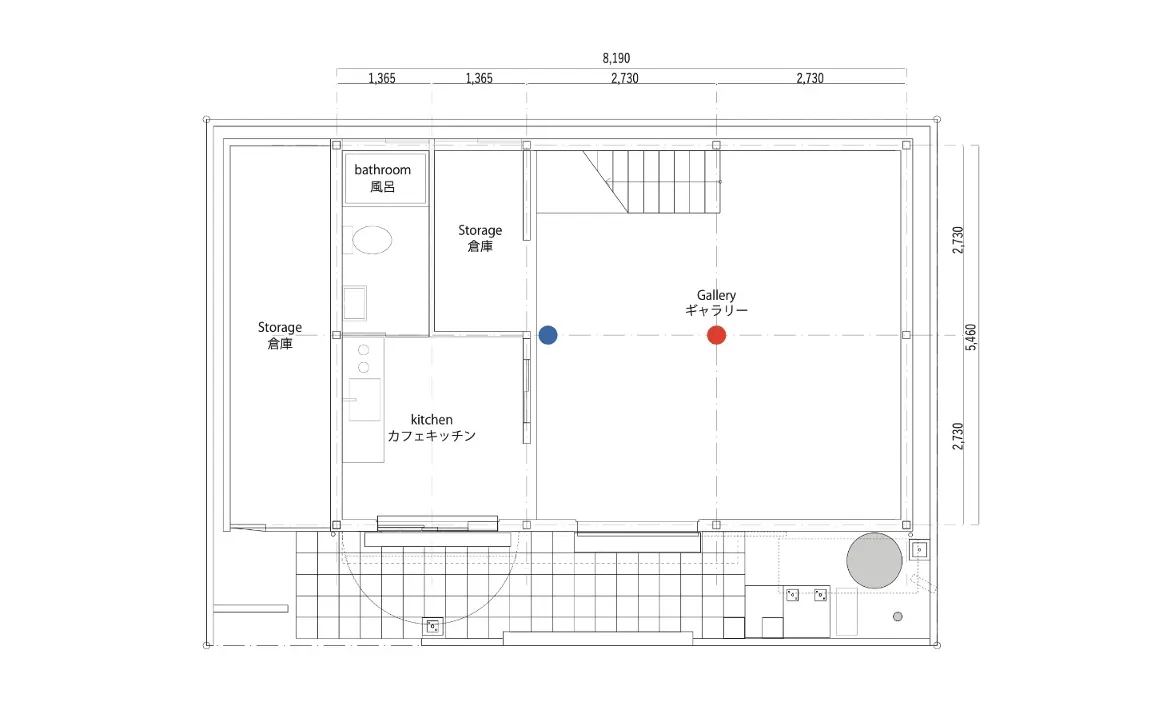
- Two column options, blue one or red one
I recently talked with a friend and we were thinking about large and small architecture. I was thinking about the public architecture that is supposed to be used by all kinds of people, and the private architecture that is used by a few people who understand the context of the architecture and design. I feel that most architects tend to be experts in one or the other. Architecture that can be used by everyone and still be satisfying on average or architecture loved only by those who can understand it.
I believe that Isozaki attempted to design both large and small architecture in this context. When Isozaki was in Kenzo Tange’s laboratory, he was always looking for the next architecture of Kenzo Tange. Isozaki’s design techniques, for example, making a space through the performance within a cube, can still be referenced today.
In a dialogue, he said
Here are a few of the aspects he must confront (all tentative and for that reason are appropriate to Demiourgomorphism):
(1) Tentative form:
To create a hypothetical, experimental, heteroterritorial, unfamiliar, uncomfortable, and minor form that can be the Other. It must not recognized in historical context, and an allegiance to the communal interior must not be established. By that token it has a sense of communal interior must not be established. By that token it has a sense of disharmony, it causes unease. Yet it does not necessarily amount to a one-sided exclusion of classicist language. For through manipulations such as displacement, disjunction, and layering, it is easily possible to cast off its implicit meaning. It is always responsive to the chora and for that reason is tentative.
(2) Interchangeability of subject and object:
to be not the One but anyone shows that subject and object are easily interchangeable. There the Other is not only accepted but is cohabited with. We should not cast into this relationship such concepts as intersubjectivity, common sense, and publicness but rather keep it in a state of discontinuity accompanied by interchangeability. Then dynamic viewpoints such as the exchange of gazes, the intervention of subject and object, encounters with alien cultures, and hybridization can be obtained.
(3) The fictionalization of topos:
from a planning viewpoint, today’s world can largely be divided into three categories: the real world-cities in which the communal context works effectively historically and in which adaptation to it is the only determining standard, European and Eastern historical cities, sedentary societies with little change; the unreal world-cities that, even as they maintain a historical context, fail to construct an effective linkage to that context, changing cities like Tokyo in which intervention and stratification of different and unrelated mechanism lead to conflict; the fictional world - non-cities, the planning of which is effected solely through an artificial frame-up in places lacking historical and indigenous context, for example theme park cities.
For the various cities that can be defined according to these three types, proposals can be modified according to the special characteristics of each locality. But common to all is that a topos filled with meaning should undergo transmutation through the intervention of the Other and that, characteristically, this bears a reset.
Arata Isozaki, Akira Asada, The End of Buildings, The Beginning of Architecture - 10 years after ANY -, 2010, pp. 228-229)
What do you think about large architecture and small architecture? If such a distinction exists, how can it be overcome?
230607/20:42(EST)/Nile, ANY
What is the distinction between large and small versus public and private? Some of the smallest architecture is most public while some of the largest architecture is most private.
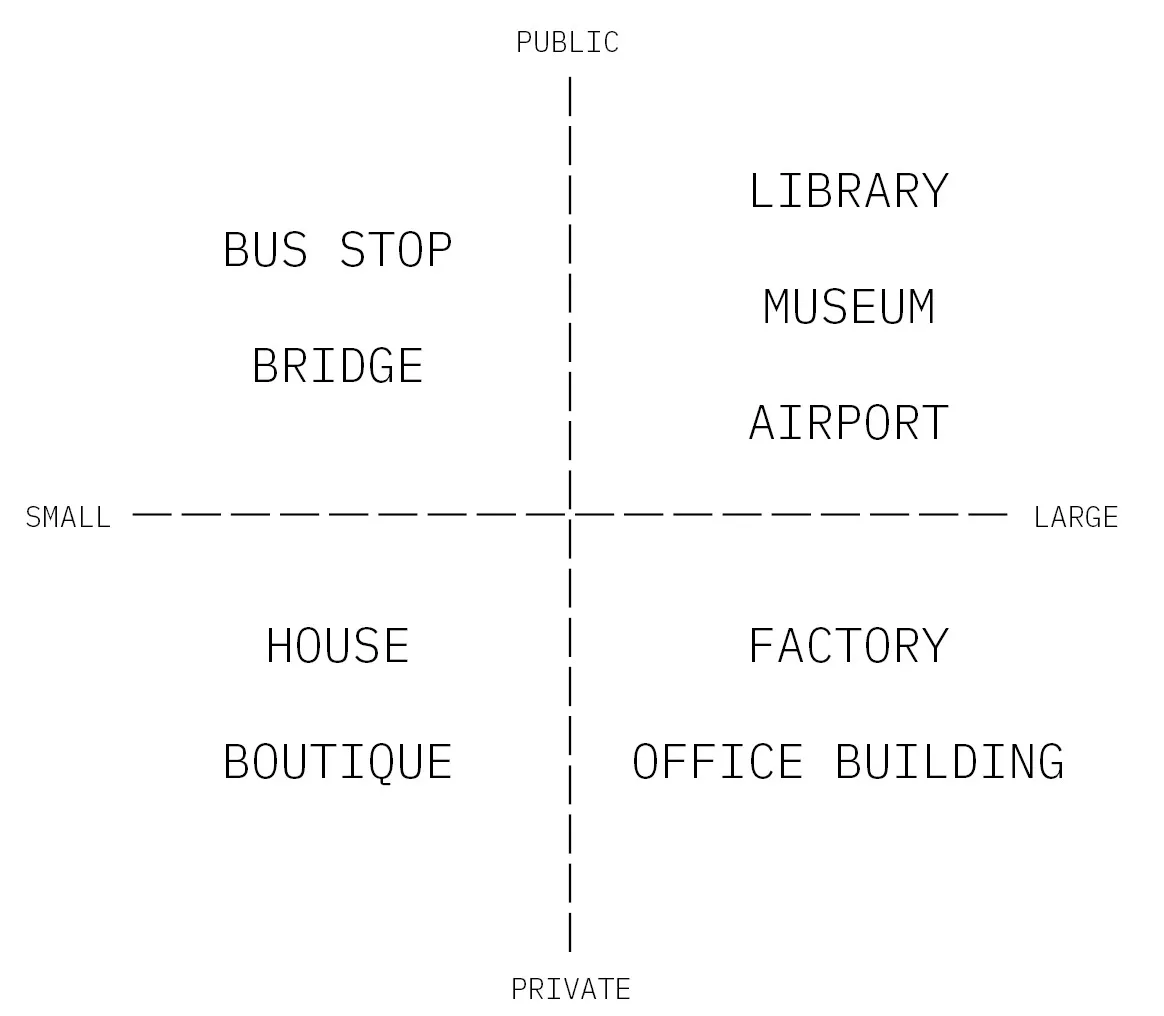
- I can imagine a two-directional axis diagram for this paradigm
As architects we must establish and codify new types of public architecture, but we must look beyond Opera Houses and Museums to find relevant public spaces.
I have an interest in a new type of public architecture that rejects this axis and partially addresses your question. Architecture that maintains the public rather than houses it. There are public buildings that dedicate their attention to storage, maintenance, repair, gardening, meeting space, backup generators, hvac infrastructure, district heating, etc. These buildings have developed new architectural forms that articulate themselves through poorly understood operations like typological camouflage, abstract objectness or prefabricated functionalism. They are coded based on their immediate setting, but their programs are determined by hardcore public needs. These new programs are not just appendages to larger buildings, but rather they are often their own small architectures. These are types of public architecture that need to be codified by architects.
I imagine this column as operating in the same way. A column in both Japanese and Western Architecture can be easily celebrated, but this column is for repair and maintenance not public confidence. We must look for new considerations.
I wonder if ANY is designing a column… how GROUP might respond… A second column?
230611/20:28(EST)/Nile, ANY
Gaku, I thought it might be interesting if you might comment on some observations of mine about Isozaki…
Some observations on Arata Isozaki:
Isozaki worked and socialized very closely with artists, but he seems unfazed by any distinction between the practices of architecture and other practices like art. His works seem to operate without an architectural bias, for instance he doesn’t seem to distinguish between the robots at Expo 70 and the Tange’s structure.
One particular interest of Arata Isozaki is his interpretation of Japanese architects being influenced by the Western gaze looking at Japan, but he seemed to have struggled over the course of his career with this possibility culminating with his lecture about Stendhal Syndrome. (AA Files, 68, 2014, pp.37-38)
The canon is very important to Arata Isozaki. He carefully tells and retells the story of exiled architect Bruno Taut visiting the Ise Shrine and studying it in comparison to the Parthenon.
Arata Isozaki’s individual projects are not the center of his practice, but rather his complete set of work and ideas from architecture, to art, to graphic design, to writing, to architectural manifesto.
Isozaki looks intensely at forms. His search is not just for architectural forms, but for generational forms, political forms, linguistic forms, platonic forms, critical forms.
In 1958 Isozaki declared in his group that “real architects should reject commissions for small houses.” (AA Files, 68, 2014, p.26 / ‘Sho-jutaku Banzai’, Kenchiku Bunka, April 1958)
Criticism is central to Isozaki’s design method.
Shinjuku White House was designed as the center of an activist movement. Its cubic open interior was a receptacle for action and arts.
Isozaki was interested in D’Arcy Thompson’s On Growth and Form (1917) which notably sat on Mies’ very limited bookshelf and which he referenced quite often to students (Also sits prominently on my bookshelf).
His essays have incredible names
- Japan-ness
- The question of small houses
- City Demolition Industry, Inc
- Process Planning
- Theory of Modern Architecture Junk
- The Demolition of Architecture
- Rumor City
Rem Koolhaas is very interested in Isozaki’s methods and critical mindset.
230617/11:11(JST)/Gaku, GROUP
Hi, I reply to some of your observations.
Isozaki worked and socialized very closely with artists, but he seems unfazed by any distinction between the practices of architecture and other practices like art. His works seem to operate without an architectural bias, for instance he doesn’t seem to distinguish between the robots at Expo 70 and the Tange’s structure.
I also believe that architecture and art are inseparable. Architects of the Renaissance left great works of art such as paintings and sculptures as well as architectural designs.
However, the scope of architectural design today has become increasingly narrow, and architectural proposals themselves have become so specialized that they may be incomprehensible to those who are not interested in architecture. Isozaki may have been designing architecture with a certain nostalgia by thinking of architecture along with art as a matter of course. As a result, he could be said to be following the trend of increasing the brand power of the Architect’s own name.
One particular interest of Arata Isozaki is his interpretation of Japanese architects being influenced by the Western gaze looking at Japan, but he seemed to have struggled over the course of his career with this possibility culminating with his lecture Stendhal Syndrome.
The canon is very important to Arata Isozaki, he carefully tells and retells the story of exiled architect Bruno Taut visiting the Ise Shrine and studying it in comparison to the Parthenon.
I feel that placing traditional Japanese architecture in the context of Western architectural history is an important proposition for many Japanese architects.To be Japanese in the eyes of the West is one of the survival strategies for Japanese architects worldwide.
I am interested in being designed by the gaze, not only by the Western gaze.
Just as a bird sanctuary is protected by an environmental group that observes it, a large area of land is protected and created when people look at something, generating activity.
In the same way, it could be said that Japanese architecture has been created by the Western gaze on Japanese architecture.
Arata Isozaki’s individual projects are not the center of his practice, but rather his complete set of work and ideas from architecture, to art, to graphic design, to writing, to architectural manifesto.
Isozaki looks intensely at forms. His search is not just for architectural forms, but for generational forms, political forms, linguistic forms, platonic forms, critical forms.
In 1958 Isozaki declared in his group that “real architects should reject commissions for small houses”
Isozaki believed that building a house from the standpoint of livability based on a typical family image had nothing to do with architecture. For example, he believed that designing a house based on the assumption of nLDK at that time was not architecture. He also said that issues such as privacy, family structure, and the number of children had nothing to do with housing. He believed that if a house was to be designed, it had to have a long range so that the concept would remain forever, even if the house was as unlivable as Palladio's Villa Rotonda.
Criticism is central to Isozaki’s design method.
Shinjuku White House was designed as the center of an activist movement. Its cubic open interior was a receptacle for action and arts.
I believe that the Platonic form is neither structurally nor economically rational in design at times, but that the performance of the people who use it makes the place an architectural space. It makes me think about the possibility that architectural design can be created by the history of the people who have used a place.
230621/18:06(EST)/Nile, ANY
Thank you Gaku. After researching throughout this correspondence I am incredibly impressed with Isozaki’s career and clarity.
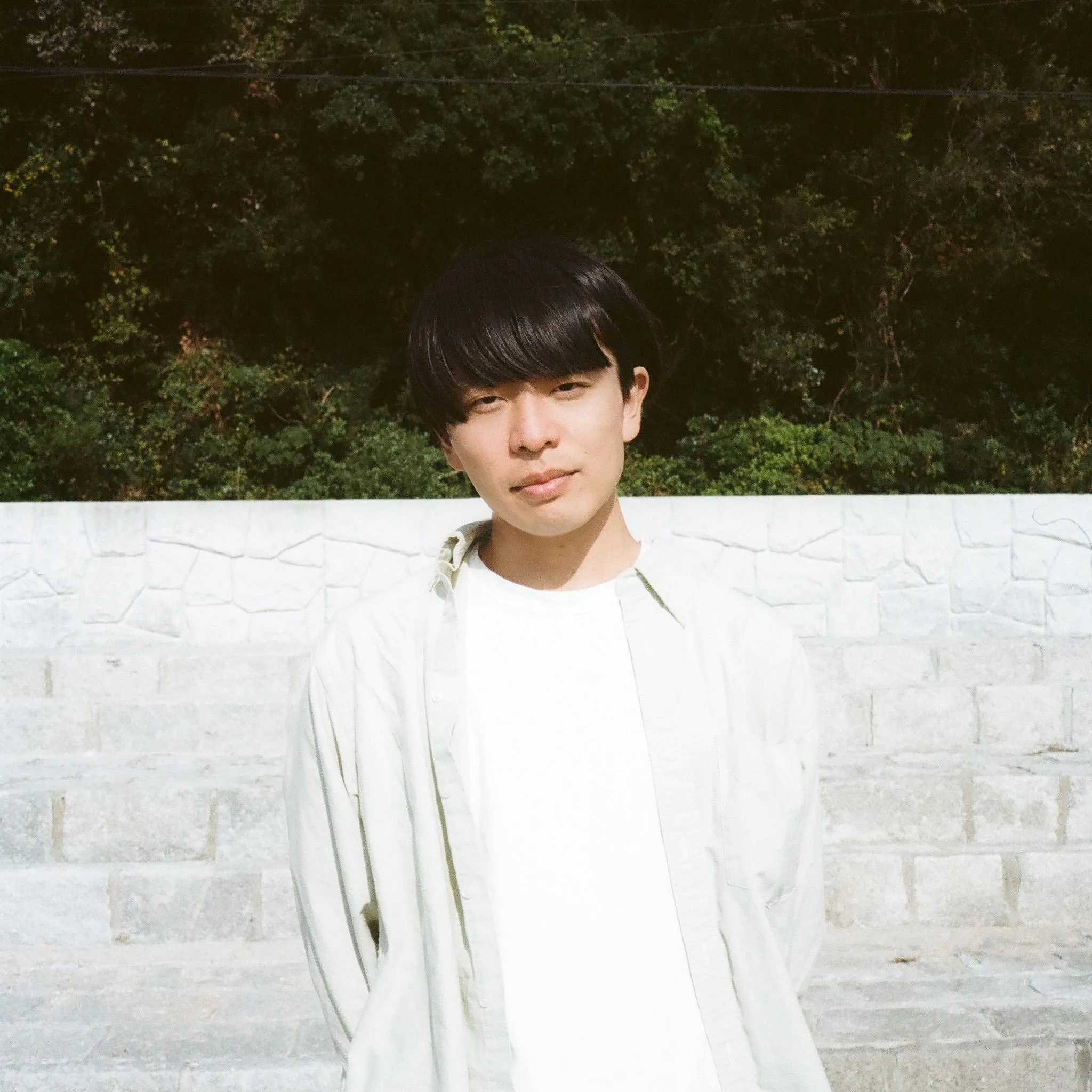
- 井上岳/Gaku Inoue from GROUP
- 建築に関わる設計と研究と施工を行う。石上純也建築設計事務所を経て、都市、建築、デザイン、アートの分野横断的な実践を行う設計事務所GROUP共同主宰。主な作品に《新宿ホワイトハウスの庭の改修》《海老名芸術高速》《浴室の手入れ》など。主な編著に『ノーツ「庭」』など。 Architect, Ph.D. (Engineering). Engaged in design, research and construction related to architecture. After working at Junya Ishigami Architects, he co-chairs GROUP, a design practice that engages in cross-disciplinary practice of urbanism, architecture, design, and art. Major works include Garden besides Shinjuku WHITEHOUSE, Ebina Art Freeway and Repair of Bathroom. His major edited works include Notes vol.1 Garden.
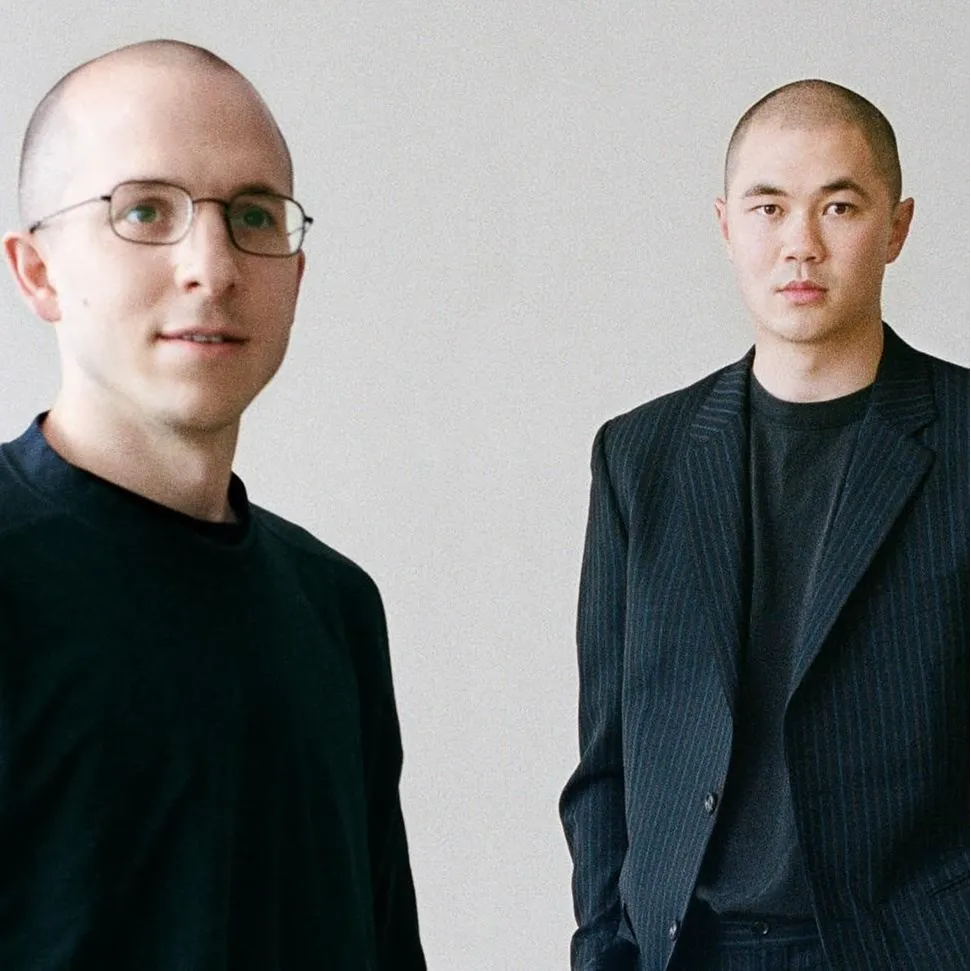
- ANY
- マイケル・アベル(右)とナイル・グリーンバーグを中心にニューヨークで結成され、アーバニズム、建築、舞台美術、デザインの領域で活動している。 現在進行中のプロジェクトには、ニューヨークのOBG本社、マナー・ロック・ファーム、ウェスト・カナダの複合住宅、長編映画のプロダクション・デザイン、複数の高級小売店などがある。 竣工したプロジェクトには、《ホーマー・ストア》(2021年)、《カフェ・フォーゴット・ニューヨーク》(2021年)、《カフェ・フォーゴット・ノードストローム》(2022年)、音楽フェス・コーチェラにおけるフランク・オーシャンの舞台デザイン(2023年)などがある。 コーネル大学、プリンストン大学、AIA建築センター、メルボルン大学、クーパー・ユニオン、コロラド大学で講義を行っている。アメリカ建築家協会NY支部からNew Practices New Yorkとして表彰され、ギャラリーSpazio Maiocchiや、Pin-Up誌、Kaleidoscope誌で作品を発表している。 ANY is a practice in urbanism, architecture, scenography and design that was formed to work on and in New York City. ANY is led by partners Michael Abel(right) and Nile Greenberg with designers Reese Lewis and Ezekiel Binns [...] Select ANY projects currently under design and construction include OBG Headquarters in New York, Manor Rock Farm in New York, a 20,000 SF mixed use housing complex in West Canada, Production Design for a feature film, and multiple luxury retail stores. Completed projects include the Homer Store (2021), Cafe Forgot NYC (2021), Cafe Forgot Nordstrom (2022), Frank Ocean’s Headlining Coachella stage in Indio California (2023). ANY has recently given lectures at Cornell University, Princeton University, the AIA Center for Architecture, University of Melbourne, The Cooper Union and the University of Colorado. ANY was awarded as New Practices New York by the AIANY and has presented work at Spazio Maiocchi and in Pin-Up and Kaleidoscope magazine.
#1 suzuko yamada architects ⇄ Chibbernoonie < 前の記事
次の記事 > #3 Korogaro Association/Kengo Sato Architecture Office ⇄ Departamento del Distrito