

F2-2-1
Part2 往復書簡/Correspondence
#1 suzuko yamada architects ⇄ Chibbernoonie

4 pairs of Japanese and North American architects exchanged texts and images before opening the exhibition at Shinjuku White House (currently, members-only art space “WHITEHOUSE”) and “a83” in New York fall 2023. Each pair shares conversations on a document-sharing file online between them and processes to make the installation together. #1 is a correspondence between Tokyo-based architect Suzuko Yamada and the Princeton-based architectural unit Chibbernoonie. (For more information, please see #0.)
-
Contents
-
230428/19:45(JST)/Suzuko
Hi, I just visited Isozaki’s Shinjuku White House today. It was dark because of the exhibition which just started. Gaku will share better photos of the house later, but in the meantime, I’ll post photos of the exhibit room that I took today.
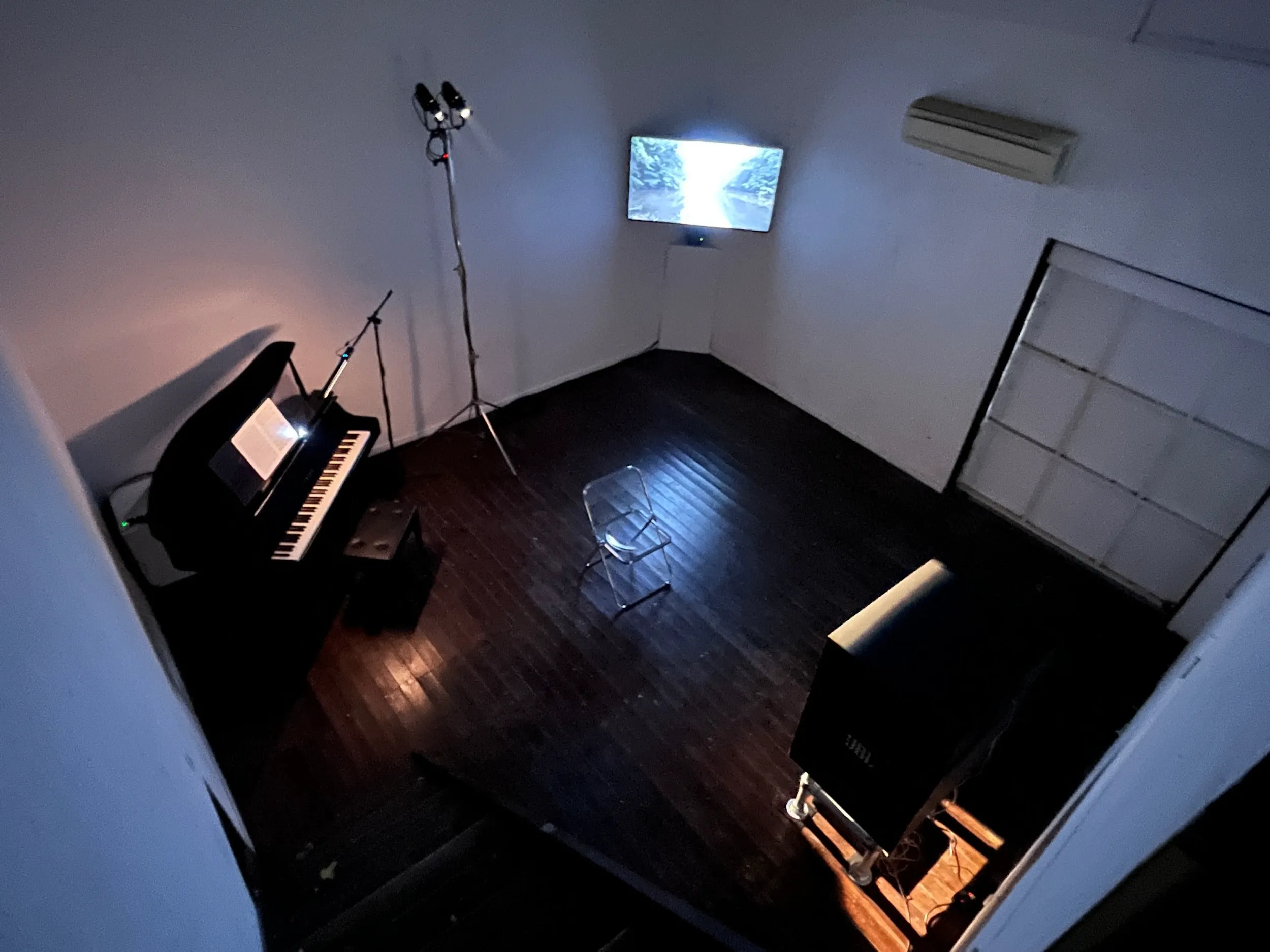
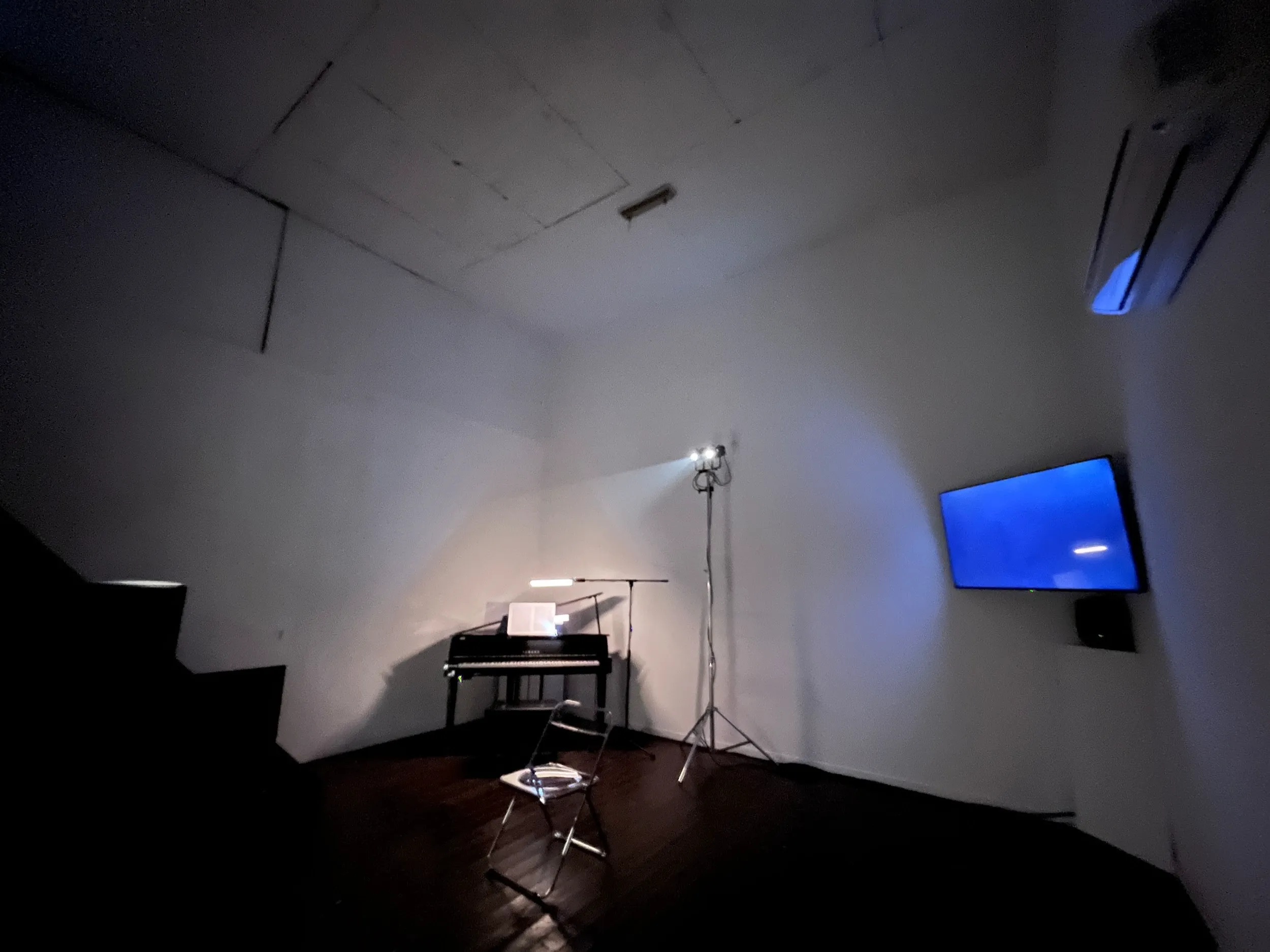
- This is the exhibition space: Width 5.4m, depth 5.4m, height 5.4m cube
Photos: Suzuko Yamada
And I found some pictures of the exhibition space when it was used for the atelier of the artists.
230429/5:50(JST)/Suzuko
We can also use the upper floor. There is also a small exhibition space. At the time of its completion, I think this would be the only white cube in Japan.
Yesterday, while looking at the venue, I was thinking about what could be done, and it might be interesting to think about the floor. The current floor is covered with the flooring that has been in place since the building was completed. The flooring can be removed and stored, either partially or entirely. When the flooring and the thin boards underneath are removed, there is a cavity of about 60 cm under the flooring, leaving the ground exposed.
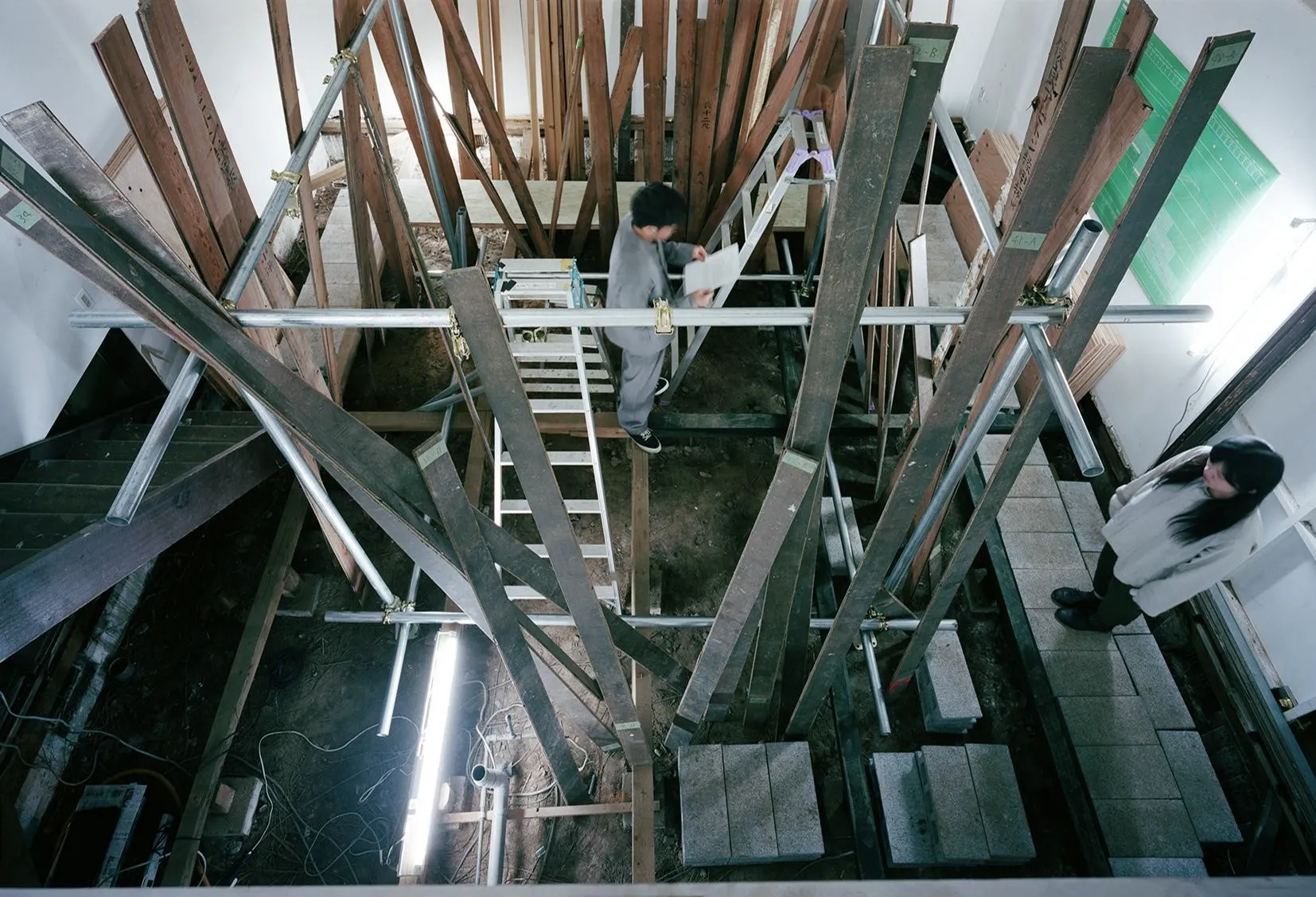
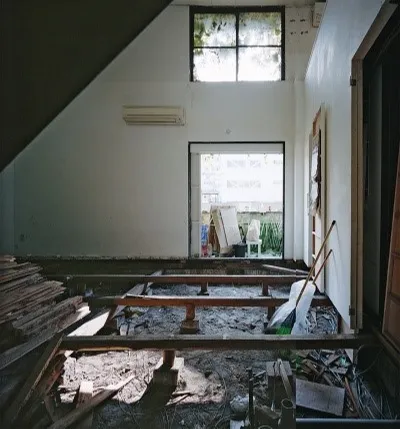
- Photos: Yurika Kono
230503/22:13(EST)/Clara, Chibbernoonie
Hi Suzuko,
The floor and floor cavity seems like a promising direction. Thank you for sending these photos. We started drafting this message to send you before having read yours, so our thoughts don’t directly relate to what you have shown us above. While we digest what you’ve written here are some of our initial thoughts:
Before seeing your entries above, Owen and I were discussing that since we can’t visit the gallery, but we work/live in a gallery ourselves that a possible design approach would be to propose an intervention that addresses a common white cube gallery condition and could be prototyped as one version specific to Shinjuku White House/WHITEHOUSE for the exhibition in Tokyo in September but then also prototyped as a second version in New York for the exhibition component in the United States at a83.
In our space, we are in need of something like a book cart that could collect printed matter associated with the gallery, past/present exhibitions, and the history of the space. Some kind of shelving that would allow us to operate a small bookstore/hold publication references would be very helpful to us. I wonder if this would be something WHITEHOUSE would like or find useful too?
If we decide to go in this direction, it seems important that whatever form the shelving takes, the design would minimally interfere with the white cube-ness of the space. For example, it would definitely not want to be permanent shelving that takes up valuable wall space, and it would also not want to be a design object that competes for attention with the exhibitions themselves. Maybe this shelving would have to be moveable or something that could be easily concealed? Perhaps the shelving could be part of the floor/occupy the floor cavity?
Part of our own desire for a book cart is because Owen and I have found that there are only a couple of places to look at architecture books in NY and usually they are sections within larger more generalized bookstores or they are libraries within architecture schools. Are there many places that have good collections of architecture/design-specific books in Tokyo? Where do you get your books?
230505/12:00(JST)/Suzuko
Hi Clara,
Thanks for your reply. Your gallery looks very attractive, and I look forward to visiting the place!
Shinjuku White House has a small room at the back of the second floor that is filled with bookshelves. In that sense, I’m a little unsure if book storage space is needed in the gallery space at Shinjuku White House, but I’ll ask. In your image, would it be best if the bookshelves were built in Japan and then brought to the US?
There are several bookstores in Tokyo that specialize in architecture. All of them are interesting because the owner’s taste is biased to some extent. Are you trying to create a permanent bookstore space in the gallery?
As for the white cube that Isozaki created, I think it depends on the way you think about whether it needs to be kept that clean. If Isozaki were to participate in this project now as a young architect, I am sure he would change the space drastically. Shinjuku White House has always been a very free gallery, so to some extent, I think it would be good to renovate it while presenting our current contemporary values.
230505/2:46(EST)/Clara, Chibbernoonie
Looking forward to hosting you!
We were thinking that the book cart would be site-specific, and there would be one fabricated and installed in Japan (this would be where the allotted exhibition funding would go) and a second one fabricated and installed in the US (as an extra element not required by the exhibition brief, therefore, the extra cost of making an additional prototype would be covered by a83). That way the design principles could be developed for the Japan installation and then applied in two different contexts (without the need to ship anything!). Our thought being it could be helpful to preemptively think about how to present the design intervention at WHITEHOUSE in the corresponding exhibition in NY at a83. BUT it sounds like WHITEHOUSE/Tokyo doesn’t share the same needs as a83/New York regarding places to browse through idiosyncratic collections of architecture books in person. So let’s set that idea aside for now except I think it’s important to keep in the back of our minds to be designing for how this installation in Tokyo in September will be represented in New York in October. Very tight turn around!
Thinking about your comments and how we might start to define an approach to the collaborative design project, do you think this intervention should be in the spirit of Isozaki? What parts of Isozaki’s architectural practice are the most poignant/relevant to you or do you think we could reference in our work? (From our experience what we know most about Isozaki are his images because of their extensive circulation in the US. Do we want to involve screenprinting? Owen and I use printmaking as part of our design practice, we mainly do screenprinting, we also make prints for other architects. Isozaki’s prints are iconic and are constant references for us although we have not spent much time experiencing Isozaki’s work (both on paper and built) first hand. Through Owen’s father, who was a printmaker working with architects and artists in NYC from the 1970s-90s, we are familiar with the general moment of architectural image making Isozaki was operating in however, from a very US-centric vantage point.) Should the intervention have utility? Should it be designed to remain beyond the exhibition duration and be incorporated into the longer-term operation of the space? Or should it be more ephemeral? Would it be possible for you to draw a section of the floor as it exists now? I’m curious about how porous the interior of the gallery is to the exterior. From the images and your description, it seems like the only barrier between the dirt and the white cube interior is the (wood?) floorboards. Would we want to exaggerate or employ this condition/proximity? Is this typical for construction in the WHITEHOUSE neighborhood? In our neighborhood in NYC land is so extensively built up with concrete and other kinds of building materials that coming across “organic” matter is a rare occurrence. A lot of the cast iron buildings in SoHo have these really extensive basements that go several stories down. Probably the best place to go to see some dirt in SoHo is the Earth Room by Walter De Maria.
Here is a reference that came to mind (perhaps useful but maybe just entertaining) while thinking about the floor cavity and the size of that space relative to the scale of the gallery. The artist is Walid Raad, and his work, The Atlas Group(1989-2004), would give us a hint.
230508/16:20(JST)/Suzuko
Thank you for many ideas and references.
I am now discussing with Gaku and the other Japanese architects, whether it would be better to have some clear objectives and programs, such as turningShinjuku White House into a library for a limited period of time.
Shinjuku White House was originally built as a residence and gallery, but there are no plans to use it as a residence anymore. It could be renovated as a contemporary or near-future art gallery, updating the White Cube, but it would be better to have a vision that all teams can share. We will be discussing this within the next few days and I will keep you updated.
230511/3:01(EST)/Clara, Chibbernoonie
OK. That makes a lot of sense. Yes, please keep us updated.
230525/18:20(JST)/Suzuko
Sorry, I have not been able to contact you for a while. It has been decided that each architect will plan each work to be produced at Shinjuku White House. Therefore, it seems that there is no longer a need to rush to discuss with you about the production or intervention.
I see that the budget has changed a bit, but of course, it is possible to build movable bookcases in Shinjuku White House.
And I would like to ask you a few questions about your works, because I found all of your works on your website to be very beautiful. I am interested in the fact that the models in your works such as Chicago Cafe, Model Studios, and Visiting Michael's Grave are presented as if they were three-dimensional drawings. Also, in some projects, it is interesting to see the relationship where the graphic comes close to the real and the real comes close to the graphic. Do you have any philosophies or concepts regarding this way of expression?
230603/2:29(EST)/Owen, Chibbernoonie
Thank you, Yamada-San, for your curiosity in some of our representational work.
We like drawing, for its deceptive nature. We also like it as a tool for projection and for the communication of ideas. We are also a strong believer in the physical model, as a direct form of spatial representation. Drawdels are both drawing and model. The combination of techniques has potential to produce effects of both clarity and obscurity. One interesting aspect of a drawdel for us is confronting the existence of both illusion and reality within an image. This confrontation can produce simultaneous projections, one of the rendered surface and the other as an object interacting with light in space.
This simultaneous projection or “double-layered code” is something that we have found in Arata Isozaki’s representational work, his writing, and in the buildings themselves.
For example:
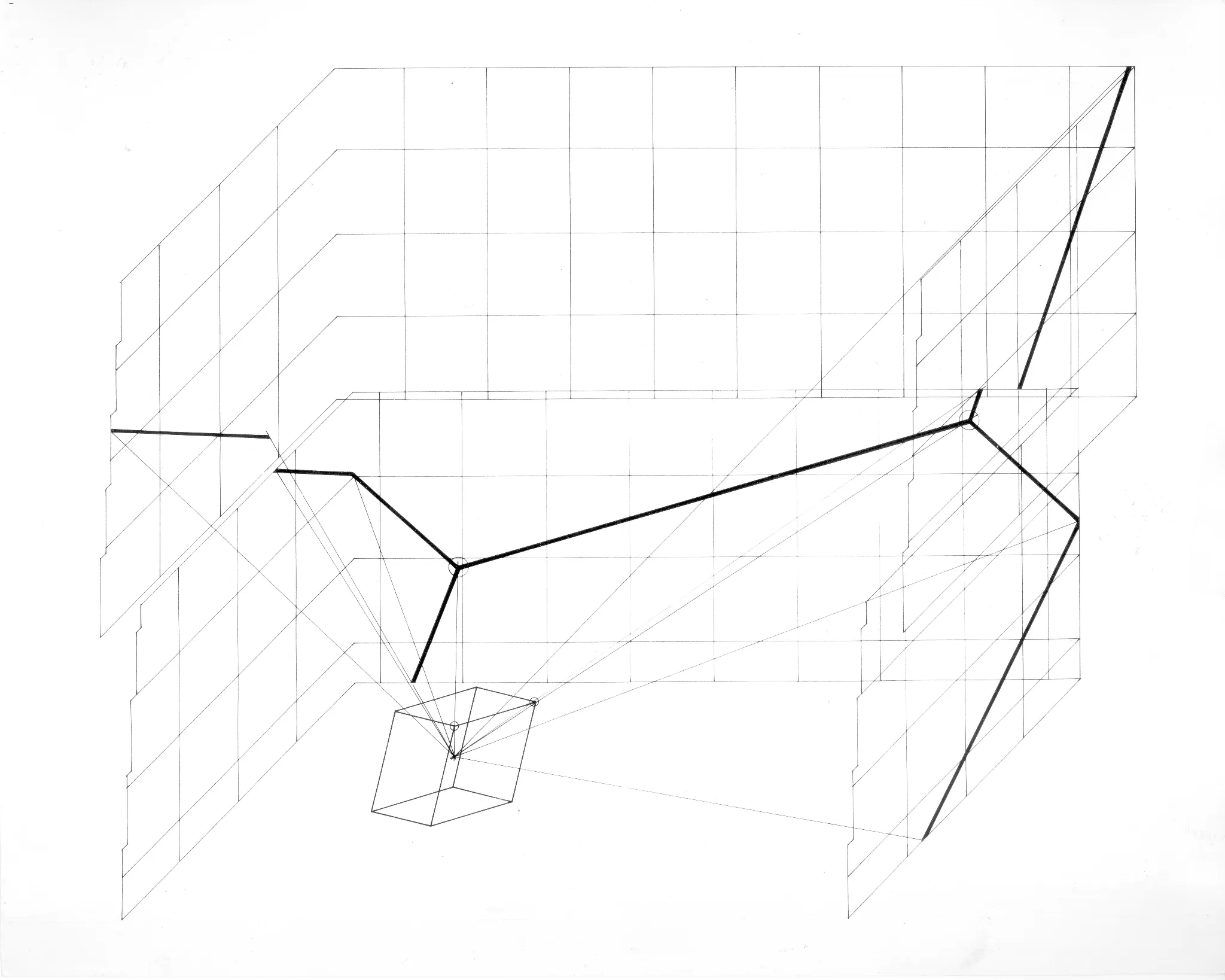
- Auditorium: shadow of slanted flame, The Museum of Modern Art, Gunma, 1971-1974
©︎Estate of Arata Isozaki
This drawing by Isozaki called “Auditorium: shadow of slanted flame” seems to depict a plan oblique projection of two volumes of an auditorium within the Museum of Modern Art, Gunma, 1971-1974. An imaginary flame, slanted, and located on stage, projects light onto the walls and ceilings. There is an imaginary frame surrounding the source of light, which looks like a rectangular prism, but strange. This prism has an alternate projection from the volumes of the architecture. The shadow of the prism is projected from the single source onto the two interior volumes of the auditorium.
It seems like an incredible amount of effort for the architectural effect. This drawing is a mystery. We’ve traced the drawing several times and have separated it into layers. This helped us better understand what is happening in the drawing, but we still are unclear about the geometry of the projected frame, its location, the slant, and the reasons behind all of it.
This conundrum occurs in Albrecht Dürer’s Melencolia I (1514). The artist in her studio with every tool she could possibly need, also a cute dog and a bat, announcing her sorrow. The artist glares at the insurmountable geometry of the massive object in the middle ground.
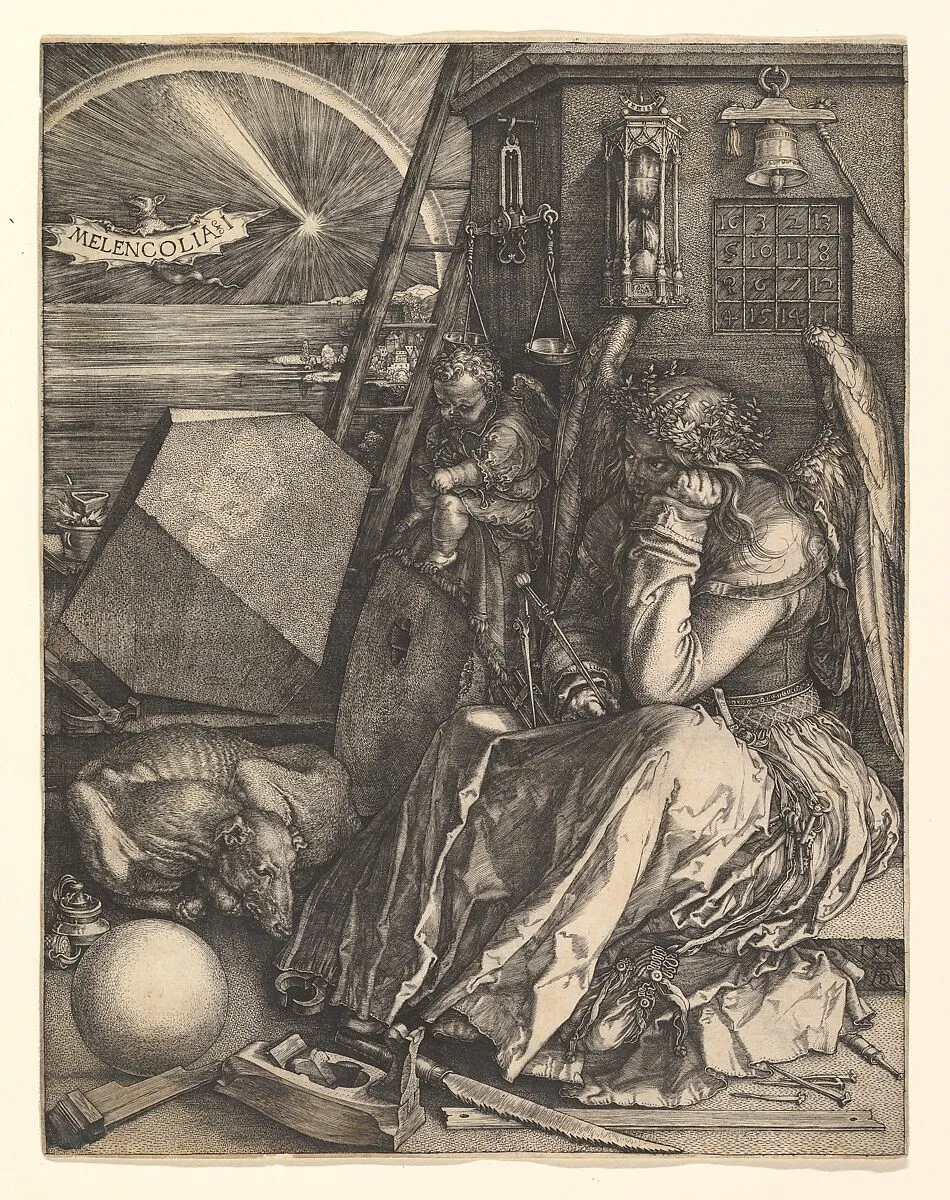
- Melencolia I (1514)
Isozaki writes about the Gumma Museum:
“Getting this public commission at a time when I was recovering from the crisis after Expo ’70 was extremely fortunate from the point of view of my career as an architect. I decided to concentrate on developing a new method. I had already begun to experiment in the work in Fukuoka, but I really gained confidence designing this museum. The approach I used has much in common with mannerism and conceptualism in art. It is practically impossible to reduce architecture, which must accommodate various functions, to a sculptural object. However, the code generating meaning in a material object that has been reduced to abstract signs and the code suggesting conventional architectural meaning can be made to alternatively appear and disappear, relating in a new multilayered code. The double-layered code appears in my subsequent works. At times the two layers are only slightly distinguishable, and at other times they offer a clear contrast. I began to feel that my design style demanded that I avoid using just one code.”
(GA Architect 6: Arata Isozaki Vol.1, 1959-1978, ADA EDITA Tokyo, 1991)
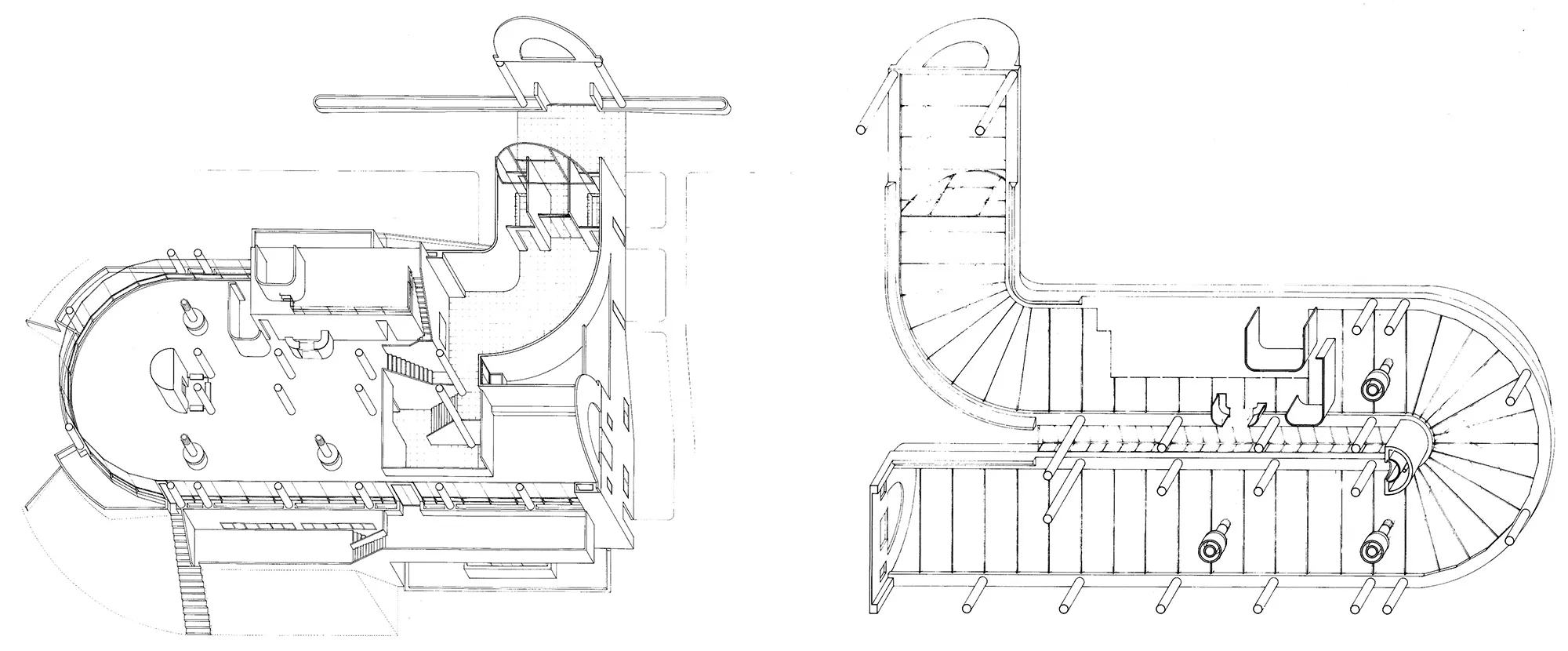
The new method Isozaki deploys seems to mostly be (from our limited source material) a series of idiosyncratic games or experiments being played out or tested within Isozaki’s drawings. Here are a few examples (below) where these drawing board games manifest into the architecture. Most of the idiosyncratic games being played seem to have to do with his obsession with shadows and shadow projection. Perhaps the essay he wrote in 1964 called “Space of Darkness” will provide some clues.
230605/18:10(JST)/Suzuko
I am sorry for taking up so much of your time trying to talk about something about Arata Isozaki, but I didn’t know where to start.
I find your use of drawings and models and their relationship to Isozaki’s drawings very interesting. Architecture is a three-dimensional entity, but drawings are on two dimensions. When you proceed with a design in two dimensions, no matter how many drawings you make, they can never 100% explain the real three-dimensional building, can they? There will be some kind of a gap, or margin, there. It is a gap that cannot be created if the building is designed in three dimensions. Looking at the drawings for the Museum of Modern Art, Gunma, I feel that Isozaki was consciously thinking about such issues.
I had thought that the elevations of Isozaki’s buildings were very two-dimensional, but when I saw the drawings for this museum in Gunma, I was surprised to learn that the two-dimensional drawing lines were drawn within the space, and not on the walls or floor surfaces, but on the three-dimensional surfaces. Perhaps it is not two-dimensional information that is visible to the eye, such as a building’s development or floor plan, but rather a line that draws between things, or in other words, a line of relationship.
230606/12:00(EST)/Owen, Chibbernoonie
Yes, I agree with you that this inevitable gap exists between drawings and buildings. Also, between ideas and drawings.
There is something about the Isozaki drawing “Auditorium: shadow of slanted flame” for the Gunma project. It stands out from many of the other drawings produced in the studio. It is not a proposal, nor really a clear explanatory drawing, rather it simply presents a problem that the office found interesting to work on at the time. Surprisingly, GA decided to publish the drawing in GA Architect 6: Arata Isozaki Vol.1, 1959-1978(1991)which stands alone amongst many proposals for buildings in the form of architectural drawings and artistic renderings.
If an office makes a drawing of a project, that drawing is typically meant for one of three people, the client, the architectural community, or for themselves. It seems that this drawing of Isozaki belonged to himself.
WHITEHOUSE gallery project provides an opportunity to make a series of images, concurrent to the realization of the project, that express the key ideas held within. Photography will play a large part in the dissemination of the project. Which allows other mediums to explore topics that photography cannot.
Clara and I think that a project dealing with the floor of WHITEHOUSE is a promising direction. We are planning to travel to Tokyo for about 2 weeks in July. Perhaps we can be helpful in the realization of the project while we are there.
There is also something about Isozaki’s buildings which you describe as being two-dimensional. I agree that many of the buildings have a clear confidence about them. The building facades, for many of the buildings, present themselves as if they were composed images. Discernable figures are presented frontally, and a supporting fleet of building fragments helps frame the main character. Isozaki sometimes presents a graphic treatment alongside the architectural forms. The Team Disney Building for example has a discernible two-dimensional drawing, enlarged in scale and wrapped around the complex geometry of the main entry volume. A double-projection, a two-dimensional drawing enriching a three-dimensional building.
230606/16:28(JST)/Kokoro, suzuko yamada architects
Thank you for sharing the attractive relationship between your works and Isozaki’s, and also rapid replying!
Considering the texts and works of Isozaki, I think that other factors are needed to make “double-layered code” come into existence. That means only two codes, like shadows and shadow projection, are not enough to make his architecture.
The codes Isozaki hid under his drawings are complementary to each other, therefore the one’s raison d’etre is the other, and vice versa. If one of them disappears, the other one also loses itself.
This fragile relationship gives the space a strong tension that is so attractive to us.
It seems coexistence is essential to realize that situation, but it’s insufficient, I think. Something to tie both codes is necessary. That is required to have power to cross over dimensions.
I think that “Auditorium: shadow of slanted flame” is one example to show his trial to overcome strong restriction of dimensions when people think about the architecture. In the beginning, the shape of the flare reduces to “The prism” in a simple 3 dimensional way, as the device to decide where the lines should be. It is not similar to the real flare. After that, some lines are set in the auditorium. The lines themselves are obviously 2 dimensional-factors, but the decision process (“the prism”) stems from 3-dimensional objects. At the same time, these objects are influenced by lines, because of that, 3-dimensional space is fluctuating. There is a kind of dynamism, as permanent circulation. Its energy gives a feeling of floating to us. Finally, the new geometry appears.
I think there are still other trials in his experiments, then, colors may be one of the important keywords. Colors themselves don’t have clear shapes, but its effects, sometimes, are more powerful than massive objects. At that time, the situation causes a lot of conflicts among different dimensions. He might know that, so he often used them. If so, there are other types of dimensions except for 2 or 3 dimensions in architecture, thinking about that and how to take in architecture is one of the great challenges in our era.
What do you think about it? I’d be glad to hear your opinion!
230614/16:28(EST)/Owen, Chibbernoonie
There’s a story about Henri Matisse where he paints a 10cm x 10cm square of Ultramarine Blue paint and wondered how he could make this square of blue, more blue. He experimented with a number of ways he could solve the problem but finally returned to the square and painted a 1m x 1m square of Ultramarine Blue paint next to it. He stepped back and realized that the 1m x 1m square is definitely more blue than the 10cm x 10cm square.
Just something to think about in relation to the idea that color itself can have spatial effects. Joseph Albers’ work on the interaction of color provides a demonstration of the dimensionality of different colors, especially in reaction to another.
The architectural work of Suzuko Yamada seems to engage and experiment with color in a brave and exciting way. You describe the residential projects you have completed recently as designs that have pushed the boundaries of domestic architecture, is the use of color a strategy to achieve this?
Isozaki’s Shinjuku White House pushes the boundaries of domestic architecture as well. It has been through several transformations. From a house to a studio, to a house/studio, to a gallery. The space itself has remained more or less the same and was able to accommodate these transformations.

- 山田紗子/Suzuko Yamada
- 東京都生まれ。大学在学時にランドスケープデザインを専攻。卒業後は藤本壮介建築設計事務所で建築を学び、その後東京芸術大学大学院に進学。在学時に東京都美術館主催「Arts&Life:生きるための家」展で最優秀賞を受賞し、原寸大の住宅作品を展示する。独立後の主な仕事として、屋内外を横断する無数の構造材によって一体の住環境とした《daita2019》、形や色彩の散らばりから枠にとらわれない生活を提案した《miyazaki》等の住宅作品や、樹木群と人工物が渾然一体となる環境を立ち上げる2025年大阪関西万博休憩施設(2025年公開)などがある。近年の主な受賞に第三回日本建築設計学会賞大賞、第三十六回吉岡賞、Under 35 Architects exhibition 2020 Gold Medal、2022年日本建築学会作品選集新人賞など。 A Tokyo native and University of California, Berkeley and Tokyo Art University graduate, Yamada set up her independent studio in 2013 in Tokyo, having previously worked at Sou Fujimoto Architects. In practice, she explores a distinctly experimental architecture having scooped a range of awards (such as recognitions from the Architectural Design Association of Nippon and Japan’s ‘Under 35 Architects’ exhibition in 2020) along the way. Recent work includes a number of residential projects with designs that push the boundaries of domestic architecture.

- 鈴木心/Kokoro Suzuki
- 1998年生まれ。山田紗子建築設計事務所設計スタッフ。横浜国立大学卒業後、2020年より同社勤務。主な担当作は《miyazaki》《2025年日本国際博覧会 休憩所(設計中)》《marble mountain》《centergai》。 Born in 1998. A member of suzuko yamada architects. Recent work in charge includes miyazaki (housing project), EXPO2025 rest area (ongoing), marble mountain (playset), and centergai (AR art project).
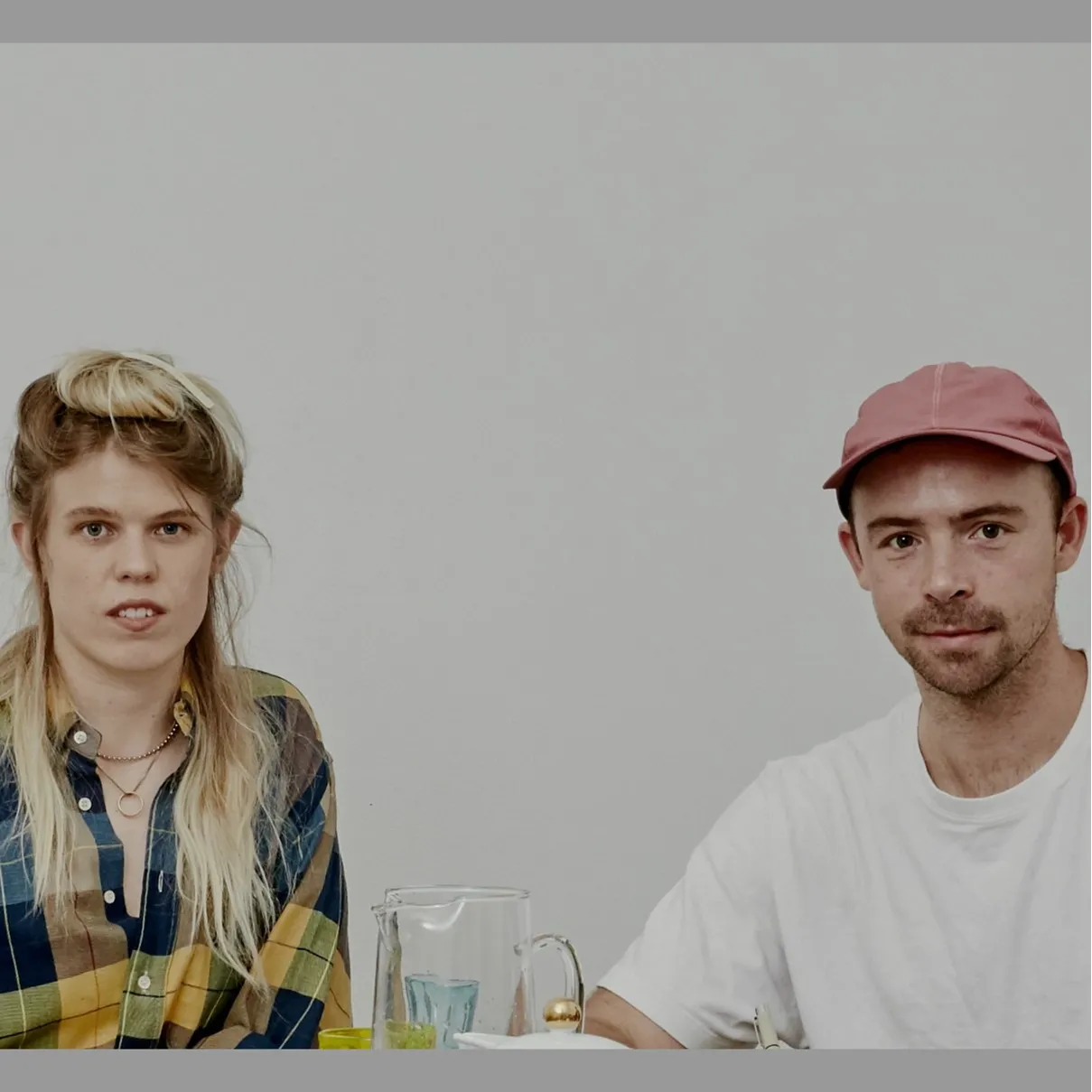
- チボムーニー/Chibbernoonie
- チボムーニーは、クララ・サイムとオーウェン・ニコルズが主宰する、ニュージャージー州を拠点とする建築デザイン事務所である。プロジェクトには、農場、学校、家、庭などがある。クララとオーウェンはともにクーパー・ユニオンで教鞭をとるかたわら、ニューヨークで、ギャラリー、版画スタジオ、アーカイブである「a83」を運営している。 Chibbernoonie is a global design empire based somewhere in New Jersey and is directed by Clara Syme and Owen Nichols. Projects include a farm, a school, a house, and a garden. Clara Syme and Owen Nichols both teach at the Cooper Union and operate the gallery, printmaking studio, and archive at a83 in New York.
#0 In Search of Communication around Architecture < 前の記事
次の記事 > #2 GROUP ⇄ ANY