

S2-2-EN
Talk with Audrey Tang #2 Democratic Competencies
Digital Direct Democracy and Universal Basic Income (UBI)
- Coordinator:Yukiko Shikata
-
Contents
-
Broadband Access is a Human Right
Rory Pilgrim: Can I ask, how do you, engage or work with this with people, like on a societal level, with different relationships or access to digital technology?
Audrey Tang: Oh, yes. That's a great question. In Taiwan, broadband access is a human right. Anywhere in Taiwan, no matter how remote, like the 4000-meter mountain, the Jade Mountain, you still have ten megabits per second broadband that you can enjoy for just 14 Euros a month for unlimited data. So, this is the currency of universal access. If we do not have that, we cannot have a Digital Democracy. It would just be an elite rule or something. And also, in basic education we stress, the idea of competence, not literacy. Literacy is when you are consumer. Competence is when you produce. So, the primary school student that measures air quality using Arduino or Raspberry Pi, the middle school students that fact check the presidential candidates as three of them are having a debate or a forum, they are all competent students making productions to the society even before they turn 18. Because people don't magically become informed citizens when they turn 18. It is only possible when in a very tender age they learn that the only way to master an art or a technique is by contributing to the commons. So, it does require an educational reform. Shifting away from standardized answers or individualized competition toward co-creation, toward the common good. And this is something that enhances the societal resilience as well. So, for us, the technologists, what's important is we always need to build with open API and public code so that the local people who prefer to interact in a different way - we have 20 national languages, 16 Indigenous Nations, 42 language variations - it's impossible for us to write a solution that works with all of them. Sign language is also a national language here, so we need to work with the civil society and the social entrepreneurs, so that they can remix our services to make more sense to their community. So is technology fitting the local needs as appropriate technology, instead of asking people to conform to our technologies. So, the mechanisms are decided. But the way the crowdfunding works and so on, there's more than two things. Three...
(again, no connection)
Michiel Zonneveld: In Leeuwarden there is no broadband access whenever you need it.
Louwrien Wijers: We see you again.
Audrey Tang: Well, I continue to see you, there's no human rights violation.
Education Curriculum Reform
Annet Schaap: Can I ask a question?
Louwrien Wijers: Yes please.
Annet Schaap: Hi, Audrey. Do you have an example on how education has been reformed in order to achieve that, contributing more to the commons and that whole different attitude?
Audrey Tang: Yes. Definitely. We completely changed our basic education curriculum in 2019. I was part of the Education Curriculum Committee, before joining the cabinet in 2016. The way the curriculum has been co-created is remarkable in that it is very transparent. All the preparatory meetings publish their transcripts. We have representatives from the school children, their parents, teachers and so on. And the most, I think, evident thing is that we don't have a standardized form of what needs to be taught anymore. We have just the core competencies and the local schools, and local teachers, can even decide to ignore the curriculum and focus only on the competencies. If they want to have a high school that does not have a campus, everything is online, that is possible. If they want to have a campus that is in the nature, that is possible. Up to 10 percent of students in Taiwan can choose this kind of experimental education that take care of the competencies without adhering to the standardized curriculum. And they, these alternative schools, join in a collaborative sharing with the basic educations that are public but want to enroll in this kind of experimental curriculum and experiment. So, there is a full spectrum of homeschooling, institutional experimental schooling, group experimental schooling, all the way to the public schools that are engaging with these teachers. I am the prime example. I've only stayed in public school until I was 14 and I dropped out. I started homeschooling. I never attended a senior high school or a college, but obviously I still know what I'm talking about. So, I think, alternative education is no longer alternative in Taiwan, but rather works like a research arm to the R&D of experimental education.
Brigitta Scheepsma: Great.
Annet Schaap: Thanks so much.
Louwrien Wijers: Iemand die iets zeggen wil?
Coexistence of capitalist and socialist parts
Brigitta Scheepsma: Hello, Audrey. I was wondering, is it possible to involve everyone, or are there people left behind in their poverty, and how… Because you said about basic income, it's linear. And how does it work with people with less money to have the security for a living?
Audrey Tang: Yes. During the pandemic times, many people wondered why Taiwan never had a single day of lockdown. People still move across cities, all for three years, and we never had anything that is a mandatory contact tracing program. You just voluntarily scan the QR code, or write down your contact number, and so on. But yet, anyone who developed symptoms simply reported themselves and self-isolated. And I think we're next only to New Zealand in terms of the health impact, and second to none when it comes to economic mitigation. And the reason why is that everyone here, residents and citizens, know it costs them nothing if they report this symptom. We have a universal service that covers not just the dentists and dentistry but has been practiced since 2003 in a digital form after SARS. So here in Taiwan, we all understand, a single player universal service for health covers all our health needs, and therefore people voluntarily cooperate with the public health system, because even if they have not actually Covid, or whatever other illness they are suffering from, it will cost them nothing anyway, including the free testing and checks and so on. So, I use, just this one example, but when in Taiwan we say something that is social, in our constitution we make a very clear separation between dentistry and so on, which is social medicine, and artificial beautification, which is not covered by the health coverage. So, we have a capitalist part, but also a socialist part, in our constitution. And so, access to health, to education, to public representation, and so on, are all free of cost. It reduces a lot of the pressure that people have, the kind of things that you mentioned, like lifting off poverty and things like that. Of course, we're not perfect. We still have a lot of transition justice to do, especially toward indigenous nations, and new immigrants, and offshore immigrants working on fishing boats, for example. But at least for people physically, as a resident living in Taiwan or a citizen, I think our safety net is pretty good when it comes to not looking at how much money you buy, because it doesn't matter, you get the same treatment.
Zero-knowledge technology
Hilde Latour: Can I ask a question? My name is Hilde Latour, I'm a deputy chair of Basic Income Earth Network (BIEN). We are approached quite regularly by big tech companies that say that they are going to implement the basic income, and our experience is that the hidden agenda is track and trace of transactions that people make with their money. How can we protect people from that hunger for people's data, behavioral data as well as biometrics and things like that?
Audrey Tang: If it is cash, how can they track you? Or are we talking about world coin?
Hilde Latour: Yes. Well, a world coin is a perfect example. And yes, I know you are aware that in the definition of basic income, we have cash just to protect the freedom at the spending end. But if we move to the digital world, is there a is there a possibility that we can use digital money and at the same time protect the people from this data theft?
Audrey Tang: Well, there is digital cash, right? Anything that offers what we call ‘zero knowledge protection’ means that I can prove I am 18 years old without telling you how old I am. I can prove that my accounts still have at least this imbalance, without revealing the balance. I can prove that I can enter into this contract freely without revealing exactly how I satisfy the requirements. And there are even technologies like designated verifier, meaning that if both of us trust an intermediator to arbitrate, we don't have to make public the fact that we have entered into a contract, and so on and so forth. So, there are a whole suite of technologies, called privacy enhancing technologies, or ETS, that specifically want to recreate the condition of anonymous cash in the digital realm. So, my suggestion is just to invest only in the companies, or the social entrepreneurs, that utilize a full suite of zero knowledge technologies. There are mature technologies, these are not research level, but they did not get as much investment as they should, because exactly as you say: it earns more profit if you can persuade your so-called customers into buying more things they don't need. So, because of this surveillance capitalism profit motive, the zero knowledge and privacy enhancing technologies need a different source of funding. And Bitcoin, and my public infrastructure projects the India Stack and the GovStack in the ITU, and so on. Many of us in the digital public infrastructure realm are now looking at it, and I think Netherlands is also part of the movement. There is a wallet called YIVI, Y-I-V-I, which used to be called IRMA, I-r-m-a, which is this kind of zero knowledge wallet. So, I would encourage you to get in touch with such privacy technologists.
Oeds Westerhof: But zero information currency is a bit a niche. Can you be optimistic about the usage of it in the future?
Audrey Tang: Yes, definitely, because now it costs nothing for random people in a random country to impersonate another person in another country. Last year it was harder to scam people. You have to know their local culture; you have to carry a conversation and so on. But nowadays, with a new technology called ‘Gen AI’ or generative AI, it costs practically nothing, anyone can run in their laptop a convincing deepfake of anyone with just three seconds of voice or sound, which means that anything that does not have this kind of digital provenance or verification, or the zero-knowledge proof that I just described, will soon be worth nothing. What used to be sellable as a scoop may now be all discredited when anyone can Photoshop any video from any description involving any person. And so, I would say: yes, this kind of community minded digital verifiable communication in a couple of years may become the most valuable and maybe the only valuable form of communication exchange, because the public surveillance capitalist source is going to be polluted by generative AI.
Oeds Westerhof: Very interesting. Thanks.
Consolidating opinions without losing nuance
Louwrien Wijers: Shall I go a question again? What is it that is solved mainly by Digital Direct Democracy?
Audrey Tang: I would say, it is the capability of coming together to common knowledge and common values in any decisions involving more than 150 people. That's the number. As humans, we cannot reliably track the theory of mind, what is going on in other people's mind, when there are more than 150 people over a long term, which is why juries and so on are always selected to be smaller groups of people, because you cannot get consensus when the room is 1000 people. On the other hand, there are deliberative or facilitation skills that use like smaller rounds and then larger rounds and then larger rounds to achieve a compression of consensus. The problem is, even the best facilitator cannot in their summary, have the nuance of their individual participants in a deliberative round. So, every time you compress, some nuance is lost, but to find the solutions to wicked problems, meaning coordination problems involving many stakeholders, the solution is necessarily very nuanced. In the Uber conversation, we have solutions saying, you know, not undercutting existing meters only works when the rural places have their self-determination that involves them in decision making and the road planning and blah, blah, blah, blah. So, all this is like 40 dimensions when you listen to the solution statement. But in traditional deliberation, these consensuses are difficult to make, especially when it involves randomly selected citizens. On the other hand, using Polis, using All Our Ideas, using Cock To The City, you can compress these without losing the nuance. Every time you compress, the newest just adds to it. And if you want to inquire the nuance, you can like ChatGPT have a direct conversation with the mathematical model of the blended volition. So, it enables more than 150 people to talk as if it's just 50 people or five people in the room. And that scales the possibility of nuance and still makes it possible to solve problems that have very unobvious solutions that would need the collective intelligence for more than 150 people to come together to find out.
Louwrien Wijers: Beautiful.
Digital Revolution and the Future of Democracy
Jan Atze Nicolai: I also have a question. I am Nicolai from the local basic income movement. I have also a question about the urgency. In my opinion, democracy is fading away in the Western world. Can democracy exist without Digital Direct Democracy? Is democracy without digital possible or is digital the only solution?
Audrey Tang: Obviously if you practice democracy constantly in your workplace, in your art club, in your union, involving 100 people or 200 people, you don't need any digital tools. The human brain is perfectly capable of coming to common decisions when it is a small community, in which case the most digital can do for you is just to take meeting notes or something like that. On the other hand, for national scale democracy, yes, I believe digital is a necessary assisting tool here, because without digital it is very asymmetrical. Every four year, if you only vote once from eight candidates, it's just three bits of information uploaded every four years. If you have a referendum with five different propositions, it's just five bits uploaded. But these uploaded bits result in decisions that affect everyday people in a very quick way. So, it's like having a very high-speed download, but no uploading or very limited uploading. But when there are societal scale risks, like the pandemic, the ‘Infodemic’, the generative AI course scams, and computer virus, we need to know what's happening on the ground every day, even every hour. With no good uploading and only a way to course correct every four years, it is impossible for democracy to solve emerging problems at a scale and a speed as they become. And so, it is not a coincidence that the states that did not have a good counter pandemic plan, fell back on the democracy scale. People don't believe in democracy anymore because it didn't deliver during the pandemic. Whereas in the democracies that did deliver during the pandemic, like Taiwan, we see a boost in democratic confidence.
Big Tech and the Reimagining of the Digital Economy
Louwrien Wijers: Great. Beautiful. Is er iemand die iets wil vragen? Is there anyone who wants to put a question?
Hilde Latour: Yes, I have another question. We see big tech, of course, implementing all these algorithms and robots and generating money for the happy few. So, what are the challenges is to bring those algorithms into the commons and have these machines generating basic income. That is my dream. What would be the low hanging fruit? Where would you start to generate value for the people? For example, you know, with the Uber taxis software. What would be the low hanging fruit to start with?
Audrey Tang: The lowest hanging fruit is instead of directly messaging each other on Twitter, we switch to Signal, right? And I'm not joking, because Signal or other end to end encrypted technologies, is the most basic of privacy enhancing technologies. The Signal Foundation, Meredith Whittaker, does not even know when you're talking to how many people, right? Even the metadata is encrypted. So, there is no way for them to profit from eavesdropping all your conversations or the way you converse, and therefore the incentive shifts toward the community. Whereas anything that let the intermediary capture what you're talking about, even though they don't plan to monetize it or to train a supervised model to let you click on the advertisement or whatever, they still retain the data and it always adds to their shareholder, their board meeting and pressure, saying, we're sitting on so many direct message data, why don't we monetize it? And so on. So just making a habit of using good privacy technology is a good first step in denying those big techs the kind of material they can use to build precision persuasion machines.
Oeds Westerhof: And if you do that, which is very interesting perspective, what consequences will it have for the economy? How do you see the development of consumerism in a model like that?
Audrey Tang: I think, first of all, the local telecoms will be more free to serve their community. Currently in the European Union I believe more than half of the cost of running a telecom is just by those few big techs that run their platforms. That makes it impossible really for the local telecom to focus on building, to reflect on local needs, because everybody is just streaming from the three platforms that everybody uses in a lot of downloads and not many uploads. And so, in Taiwan for example, we have dedicated plans for anyone to be a local telecom to their community. They cannot stream Netflix of course, but they can offer real time interpretation for the outdoor exhibition’s arts, or the conference rooms, the summit venues, and so on. Or they can make XR virtual reality to merge many different cities together into this very huge room and so on, and they get to use the same 5G equipment as the telecoms use, but they don't need to pay a very expensive license and they don't need to satisfy the need to stream YouTube or Netflix and so on. So, this kind of community scale of technologies makes it much more possible for the local people to think about your individual needs when planning technologies while still connecting to the cloud. So, I think the cloud will need to be a place where people do offload the computation but without dependence on it. If you become dependent on Google and Facebook and so on, there really is no way for the local communities to reinvest their profits into their communal needs.
Oeds Westerhof: So, you say that if you want to develop a more local economy or a more regional economy, you should invest in independent local networks?
Audrey Tang: Yes, definitely. Either a local 5G network, or a Wi-Fi Six E network, if you don't need that many outdoor connectivity, or even peer to peer sharing networks, mesh networks. These are all very inexpensive technologies because, you understand, if you use a public telecom, then you're essentially subsidizing half of your subscription fee to Netflix and YouTube and Facebook.
Oeds Westerhof: Great. Thanks.
TALK WITH AUDREY TANG
#1 CREATIVITY IS OUR REAL CAPITAL
#2 DEMOCRATIC COMPETENCIES
#3 TO "REPRESENT" ONESELF
#4 DIVERSE DEMOCRACY, TOWARD A DEMOCRACY OF PLURALITY
- Audrey Tang / 唐鳳
- Taiwanese politician and programmer, widely recognized as a programming prodigy. In 2016, she joined the Tsai Ing-wen administration as the Digital Minister. In 2022, she became the first Minister of the newly established Ministry of Digital Affairs. Tang has been a key advocate for government transparency, digital democracy, and open government. She emphasizes dialogue with citizens through social media and online forums, leveraging digital technology for democratization and social transformation. In June 2024, she resigned from government – peacefully and collaboratively – to focus on taking her vision to a wider audience.
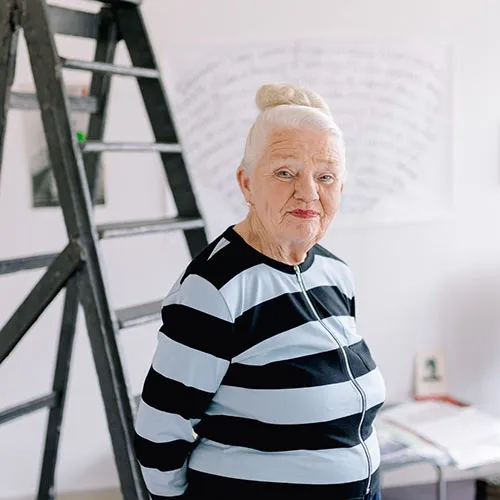
- Louwrien Wijers
- Born in 1941 in Aalten, Netherlands. An artist and writer, she encountered Fluxus in Paris in 1964. For 18 years, from 1968 to 1986, she closely collaborated with the German artist Joseph Beuys. Wijers considered “writing, speaking, and thinking” as forms of “social sculpture” (a concept by Beuys) and engaged in various fields of curation alongside her critical activities. In 1982, she facilitated a dialogue between Beuys and the 14th Dalai Lama. After Beuys’ death, in 1990, she organized the symposium “Art meets Science and Spirituality in a changing Economy” at the Stedelijk Museum in Amsterdam, bringing together prominent figures such as John Cage, Ilya Prigogine, Stanislav Menshikov, and the 14th Dalai Lama. Photo: Marleen Annema